When it comes to car lighting, most drivers don’t give their headlights much thought — until a bulb blows, an MOT advisory appears, or they spot a newer car with noticeably brighter, crisper lights and start wondering what they’re missing.
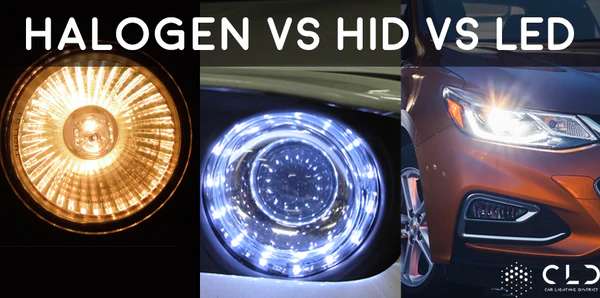
The three main types of car headlights you’ll encounter on UK roads today are halogen, HID (also known as xenon), and LED. Each works differently, performs differently, and comes with its own set of costs, advantages, and important legal considerations for UK drivers. Understanding the differences can help you make a smarter decision — whether you’re replacing a blown bulb, booking in for a car lights check, or simply trying to understand what your vehicle already has.
What Are Halogen Car Lights?
Halogen headlights have been the standard on UK cars since the 1960s and are still found on the majority of older and entry-level vehicles on the road today. They work by passing an electric current through a tungsten filament inside a glass bulb filled with halogen gas — a process very similar to a traditional household light bulb, but more durable.
The key characteristics of halogen lights:
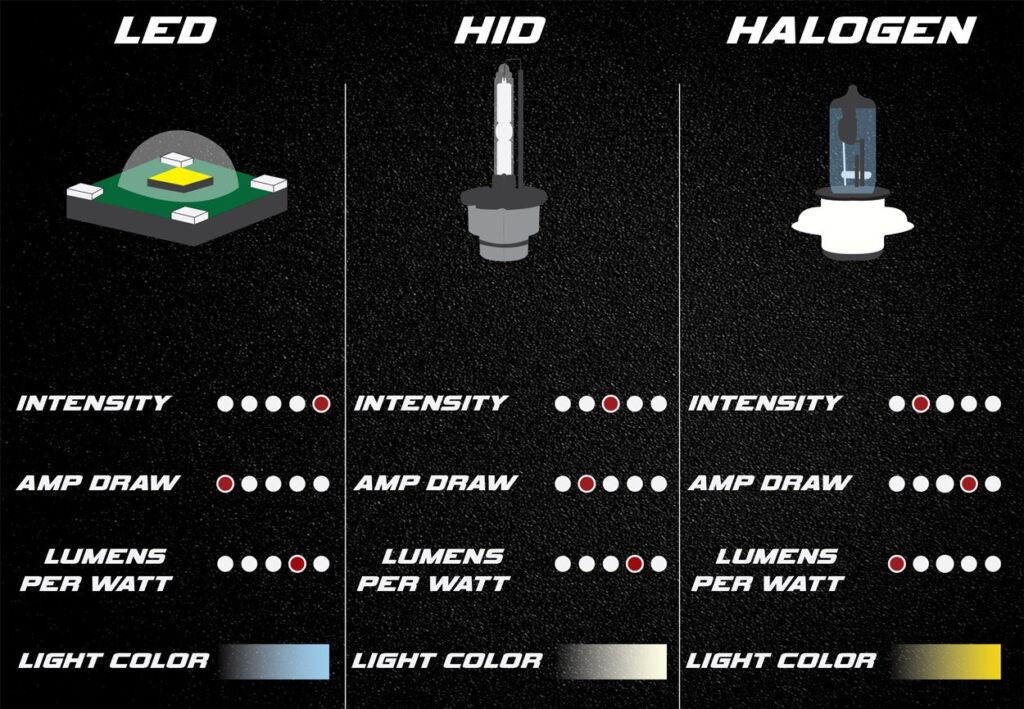
- Light output: Typically 900–1,000 lumens, with a warm yellow-white glow
- Lifespan: Around 500–1,000 hours
- Energy use: Higher than LED or HID — roughly 55 watts per bulb
- Cost: The cheapest to buy and replace, with bulbs available from as little as £5–£20
- Ease of replacement: Simple — most drivers or mechanics can replace a halogen bulb in minutes
The biggest drawback of halogen lights is efficiency. A large proportion of the energy they consume is converted to heat rather than light, making them far less efficient than modern alternatives. They also produce a dimmer, yellower beam compared to HID and LED, which can reduce visibility on unlit rural roads — a real consideration for drivers outside York city centre.
That said, halogen lights are reliable, affordable, and still perfectly legal — so if your car has them and
they’re working well, there’s no obligation to change.
What Are HID (Xenon) Car Lights?
High-Intensity Discharge headlights — commonly called HID or xenon lights — arrived on the market in the 1990s and were initially the preserve of premium vehicles from brands like BMW and Mercedes-Benz. They work by striking an electric arc through xenon gas between two electrodes, producing an intense, bright white light.
The key characteristics of HID lights:
- Light output: Significantly brighter than halogen — between 3,000 and 5,000 lumens
- Lifespan: Around 2,000–3,000 hours — longer than halogen, but shorter than LED
- Energy use: Around 35 watts — more efficient than halogen
- Cost: More expensive than halogen, both to buy and repair
- Warm-up time: HID lights take 1–2 seconds to reach full brightness, which can be a disadvantage in situations where instant full illumination matters
HID headlights deliver excellent long-distance visibility and produce a distinctive crisp, white beam that many drivers find superior to halogen in terms of night-time clarity. However, they are more complex mechanically, require a ballast unit to regulate the arc, and can cause significant glare if poorly aimed or fitted in unsuitable housings. That glare issue is one reason they have gradually been superseded by LED technology in newer vehicles.
What Are LED Car Lights?
Light Emitting Diode (LED) headlights are now the dominant technology in new vehicles, and for good reason. LEDs produce light when an electrical current passes through a semiconductor — a process with no filament, no gas, and very little heat waste.
The key characteristics of LED lights:
- Light output: Typically 3,600–4,500 lumens, with a bright, clean white beam
- Lifespan: Up to 30,000–50,000 hours — far exceeding both halogen and HID
- Energy use: The most efficient of the three, drawing significantly less power
- Cost: More expensive upfront than halogen, but cost-effective over time due to their long lifespan
- Instant-on: LEDs reach full brightness immediately — no warm-up required
LED headlights also offer greater design flexibility, which is why modern cars increasingly feature distinctive daytime running light (DRL) signatures. They place less load on the car’s electrical system, which can contribute to improved fuel economy and is particularly significant in hybrid and electric vehicles where every watt saved translates to more range.
The main downside is replacement cost. When an LED unit eventually fails, the cost to replace it can be substantially higher than halogen — in some cases several hundred pounds, depending on the vehicle. formore information you can visit The Drive — Halogen vs HID vs LED
LED vs Halogen vs HID: A Quick Comparison
| Halogen | HID (Xenon) | LED | |
|---|---|---|---|
| Brightness | 900–1,000 lumens | 3,000–5,000 lumens | 3,600–4,500 lumens |
| Lifespan | 500–1,000 hours | 2,000–3,000 hours | 30,000–50,000 hours |
| Energy efficiency | Low | Medium | High |
| Warm-up time | Instant | 1–2 seconds | Instant |
| Replacement cost | £5–£20 | £50–£150+ | £100–£700+ |
| MOT legal (UK) | Yes | Yes (if factory fitted) | Yes (if factory fitted) |
The Important UK Legal Question: Can You Upgrade Your Car Lights?
This is where many UK drivers come unstuck — and it’s crucial information if you’re considering upgrading your headlights or searching for car LED lights near you.
In the UK, it is not legal to convert a halogen headlamp housing to use LED or HID bulbs. This applies even if the replacement bulbs are sold as direct-fit replacements. The UK MOT testing manual was updated in 2021 to explicitly state that existing halogen headlamp units must not be converted to use HID or LED bulbs. If a tester finds that such a conversion has been carried out, the car will fail its MOT as a result.
This means:
- If your car was manufactured with halogen headlights, you must replace like-for-like with halogen bulbs
- If your car was manufactured with LED or HID headlights, those are perfectly legal and should be replaced with the correct equivalent
- Aftermarket LED or HID kits fitted into halogen housings are illegal for road use in the UK, regardless of how they are marketed
This is a frequently misunderstood area, and the consequences of getting it wrong go beyond the MOT — driving with illegal lighting could also affect your insurance in the event of an accident.
If you’re unsure what type of lights your car has, or whether a previous owner may have made any modifications, the best course of action is to have the vehicle inspected by a trusted local garage before your next MOT.
Which Car Lights Are Best for You?
The honest answer is: the best car lights are the ones your vehicle was designed to use.
- If your car has halogen lights from the factory, keep them halogen. Replace them promptly when they blow, and ensure both sides are replaced at the same time — if one bulb is near the end of its life, the other usually isn’t far behind.
- If your car came with HID lights, have them replaced by a garage experienced with HID systems. Correct aim and alignment is essential to avoid dazzling other road users.
- If your car came with LED lights, you benefit from excellent visibility and low maintenance. When replacement is eventually needed, use a reputable garage with experience of your vehicle’s lighting system.
Regardless of light type, what matters most is that your lights are correctly aligned, fully functional, and regularly checked. A car with well-aimed halogen lights is considerably safer than one with misaligned LEDs.
Get Your Car Lights Checked or Replaced in York
Whether you’ve noticed a blown bulb, received an advisory at your last MOT, or simply want peace of mind before your next test, Gladstone Tyres & Autocare’s car lights service in York covers inspection, bulb replacement, and alignment checking for all makes and models — halogen, HID, and LED.
Our team will always advise you honestly on what your vehicle needs, using the correct replacement parts and ensuring everything meets DVSA standards. No unnecessary upselling. No shortcuts.
Call us on 01904 653136 or visit us at Unit 1B, Outgang Lane, Osbaldwick, York, YO19 5UP. We’re open Monday to Friday, 8:30am–5:30pm.
Frequently Asked Questions
Q: Are LED car bulbs legal in the UK? LED lights are legal in the UK if they were fitted as standard by the vehicle manufacturer. Aftermarket LED bulbs fitted into halogen housings are not legal for UK road use and will fail the MOT.
Q: How do I know what type of headlights my car has? Check your vehicle handbook or look at the headlight housing itself — HID units typically have a ballast unit nearby, and LEDs produce a noticeably whiter, more uniform light. If you’re unsure, bring the car in and we’ll check for you.
Q: How often should I replace my car’s bulbs? Halogen bulbs typically last 1–2 years depending on use. It’s good practice to replace both headlight bulbs at the same time when one fails, as the second is usually close behind. HID and LED units last considerably longer and generally only need attention if they develop a fault.
Q: Will a blown bulb fail my MOT? Yes. Any non-functioning light — headlight, indicator, brake light, fog light, or number plate light — is a major MOT failure. Check all your lights before your test and replace any blown bulbs promptly.
car LED lights York, car lights York, halogen headlights, HID headlights, LED headlights UK, MOT car lights York, car lights fitting York