Seeing a plume of white smoke from exhaust pipes can be a bit of a shock, but it doesn't always spell disaster. More often than not, especially on a chilly UK morning, it's just harmless condensation turning to steam. This thin, wispy vapour should clear up within a few minutes of driving as your exhaust system gets up to temperature.
What White Smoke from Your Exhaust Really Means
When you first spot that white smoke, the key is to figure out if it's a fleeting, normal occurrence or a sign of something more serious brewing under the bonnet. Think of it like the steam from a kettle – it disappears almost instantly. If it's more like smoke from a bonfire that hangs in the air, that's when you need to pay attention.
Getting this right saves you a lot of unnecessary stress and helps you decide what to do next. A bit of condensation is perfectly normal on a cold start as moisture in the exhaust burns off. But if the smoke is thick, hangs around, and has a strangely sweet smell, it’s a red flag that something isn’t right inside your engine.
Is It Just Condensation?
Condensation is by far the most common and least worrying reason for seeing white smoke. Here’s how you can tell that’s all it is:
- Thin and Wispy: It looks more like light vapour or steam, not a thick, dense cloud.
- Disappears Quickly: It's gone soon after you start driving and the engine warms up to its normal temperature.
- No Distinct Smell: You won't notice any strong or unusual odour coming from the exhaust.
This kind of "smoke" is just a natural part of the combustion process, especially in our cooler, damp climate. It's simply water vapour and nothing to worry about.
When to Be Concerned
On the other hand, if you're seeing thick, persistent white smoke, it’s a classic symptom of coolant leaking into your engine's combustion chambers. This is a problem you need to get checked out straight away to avoid serious, and potentially very expensive, engine damage.
Problems with the exhaust system itself can also cause different symptoms, so a professional look-over is always the best bet. You can find out more about how our expert technicians handle car exhausts in York to make sure everything is working as it should. If that smoke is thick and sticking around, it’s time to investigate.
Condensation vs Coolant: A Step-by-Step Check
Figuring out what’s causing that white smoke from your exhaust can feel a bit like detective work. Your car is giving you clues; you just need to know how to read them. Let's walk through a simple process to help you tell the difference between harmless condensation and a more serious coolant problem.
First thing’s first: try the ‘Morning Start-Up Test’. On a cool morning, start your car from cold and watch the exhaust. Do you see a thin, almost see-through vapour that disappears within a minute or so as the engine warms up? That’s just condensation, and it’s completely normal.
But if the smoke is thick, white, and billows out long after the engine is up to temperature, it’s time to pay closer attention. A persistent plume like that suggests it's not just water vapour burning off.
Digging Deeper with Your Senses
You don't need fancy tools for the next part—your own eyes and nose are surprisingly effective. The smoke's specific characteristics can tell you a lot about what's going on inside your engine.
- The Smell Test: This is a big one. Carefully and safely waft a little of the exhaust smoke towards you. Condensation is basically odourless, smelling of nothing more than typical exhaust fumes. Burning coolant, on the other hand, has a very distinct sweet, almost syrupy smell. If you smell that, it’s a classic sign that antifreeze is getting into the combustion chamber where it doesn't belong.
- The Density Check: As we touched on, condensation is thin and wispy. A coolant leak creates a much thicker, heavier cloud of white smoke that tends to linger in the air.
This handy infographic breaks down the visual clues, giving you a clear path to follow when you see smoke coming from your exhaust.
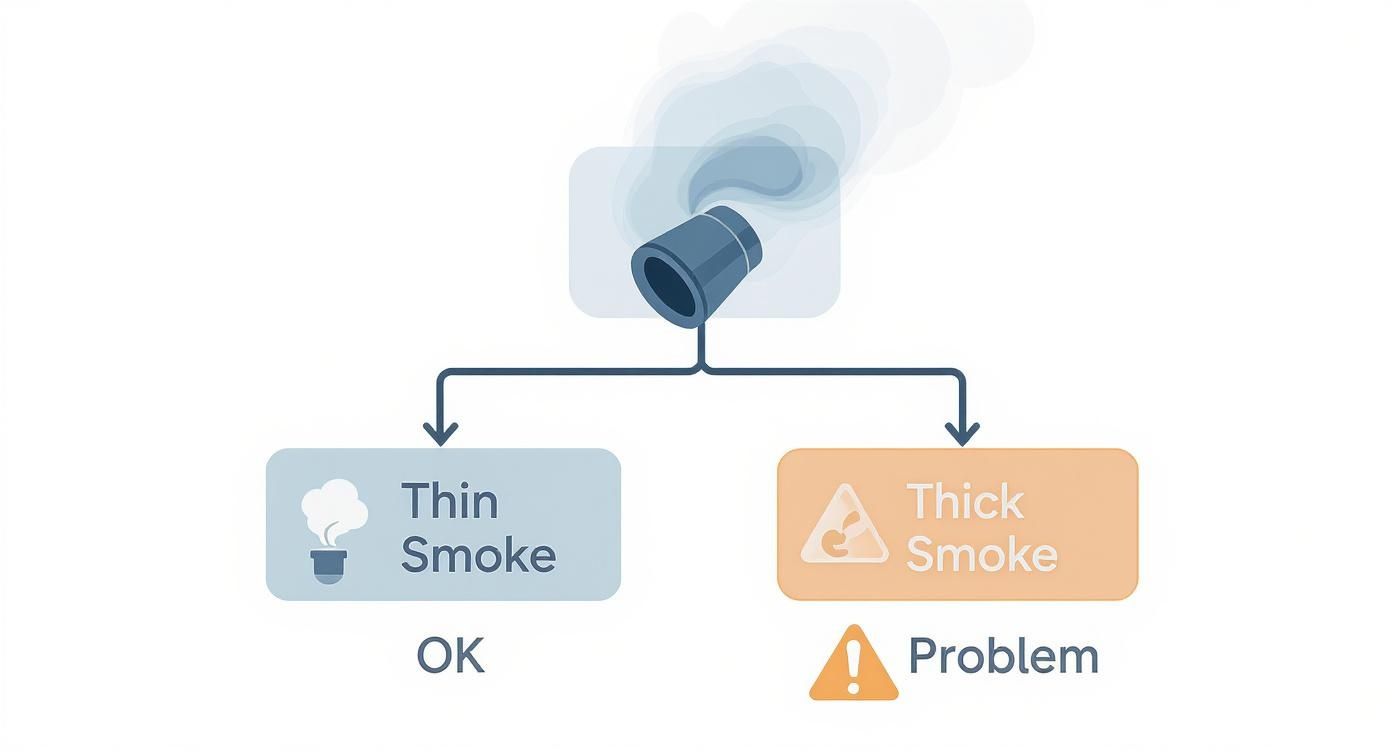
The bottom line is simple: thin smoke that vanishes quickly is usually fine. Thick, persistent smoke that sticks around points to a problem that needs a proper look.
Performing a Post-Warm-Up Check
If the clues are pointing towards a coolant issue, the next step is to pop the bonnet—but only after the engine has completely cooled down. Never open the coolant reservoir cap on a hot engine. The system is under pressure and can spray scalding fluid, causing serious burns.
With the engine cold, check the coolant level in the plastic reservoir. It should be between the 'min' and 'max' lines. If you find yourself constantly topping it up but can't see any puddles under the car, that’s a huge red flag. It strongly suggests the coolant is being lost internally, which is why it’s coming out of the exhaust as white smoke.
In the UK, these symptoms often point to a blown head gasket, a serious repair that allows coolant and oil to mix. Getting this fixed can cost anywhere from £500 to over £1,000, which is why catching it early is so important.
Remember: Persistent white smoke, a sweet smell, and a mysteriously dropping coolant level are the three classic signs of an internal coolant leak. Don't ignore them.
Of course, the best cure is prevention. Sticking to a schedule of proper car heating and cooling system maintenance is your best defence against the kind of issues that lead to a costly head gasket failure.
The Big Three Reasons Your Car Is Puffing White Smoke
If that white smoke coming from your exhaust pipe lingers long after you’ve started the car, it’s not just a bit of morning condensation. It’s a tell-tale sign that something’s not right deep inside your engine.
Think of your engine as a precision-engineered system where powerful explosions, hot oil, and vital coolant are meant to stay in their own separate, sealed pathways. When you see persistent white smoke, it’s a clear signal that those seals have been breached, and coolant is getting into a place it absolutely shouldn't be: the combustion chamber.
It sounds serious, and it is. But the problem usually boils down to one of three main culprits. Let’s break them down.
1. Blown Head Gasket
The head gasket is a thin but incredibly important seal, sandwiched between the main engine block and the cylinder head on top. Its job is crucial: it seals the combustion chambers so your engine can create power, and it keeps the oil and coolant flowing in their separate channels, never letting them mix.
So what happens when it "blows"? Usually, it's down to overheating. When your engine gets too hot, the metal components can expand and even warp, breaking the head gasket's seal. This creates a tiny gap where coolant can leak directly into a cylinder. The moment that cylinder fires, the coolant is instantly turned into steam and blasted out of the exhaust as a thick, sweet-smelling white cloud.
A blown head gasket is the most common cause of serious white exhaust smoke. It's a double-whammy of a problem because not only are you burning coolant, but the leak also compromises the cooling system, leading to more overheating. It's a vicious cycle that only gets worse.
2. Cracked Cylinder Head
Taking things up a notch in severity, the cylinder head itself can develop a crack. This is the complex metal housing at the top of your engine that contains the valves, spark plugs, and intricate passages for coolant to flow through. Just like the head gasket, it’s very sensitive to extreme temperature swings.
A major overheating event, especially one followed by a rapid cool-down, can stress the metal and cause it to fracture. This crack creates a direct line for coolant to spill into the combustion chamber, producing the same thick, continuous white smoke you'd see with a blown head gasket. Spotting a cracked cylinder head is trickier, as the crack can be almost invisible to the naked eye, requiring a proper workshop inspection.
3. Cracked Engine Block
This is the one nobody wants to hear. A cracked engine block is the most severe and expensive reason for white exhaust smoke. The block is the very foundation of your engine, the solid core that holds the cylinders and pistons. It’s built to be tough, but a catastrophic overheating episode or a rare manufacturing flaw can cause it to crack.
If that crack crosses into a coolant passage, coolant will pour into the cylinder. This doesn't just create smoke; it often leads to catastrophic engine failure in a very short space of time.
While these three are the usual suspects, there are other, less common possibilities. For instance, sometimes the issue can be contamination, and understanding the signs of water in diesel fuel can be helpful. But for the vast majority of petrol and diesel cars, persistent white smoke points directly to a breach in the engine’s cooling system.
What to Do Immediately if You See Thick White Smoke
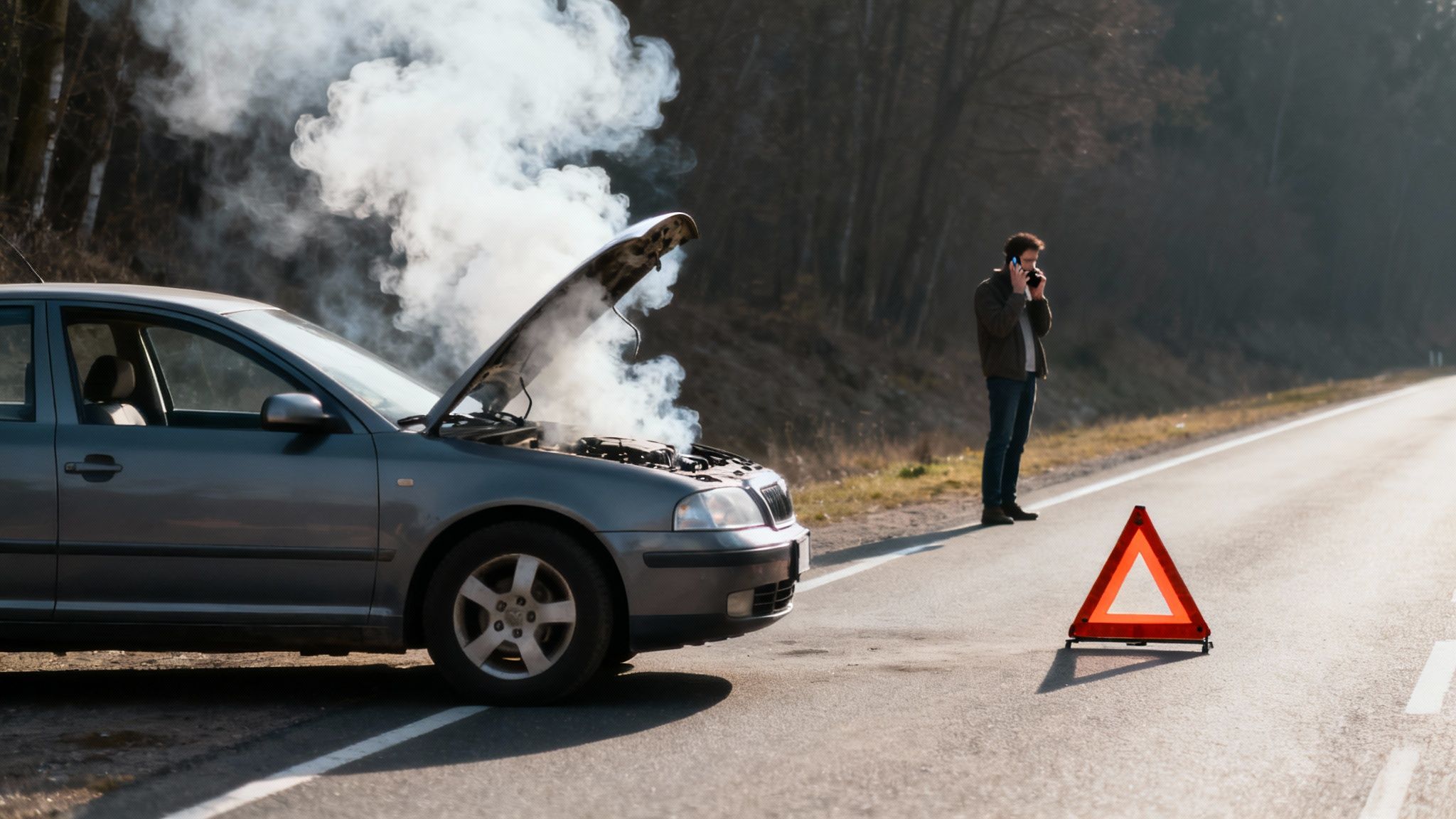
If you see a thick, persistent cloud of white smoke from exhaust pipes pouring out behind you, especially if the temperature gauge is creeping into the red, it’s a clear sign to act fast. This isn’t a situation you can ignore until you get home. Your immediate response is crucial for your safety and to prevent catastrophic engine damage.
The first and most important step is to find a safe place to pull over as soon as you possibly can. Look for a lay-by, a quiet side street, or use the hard shoulder if you're on a motorway. Get your hazard lights on immediately to warn other drivers.
Once you’re safely stopped, turn the engine off. Don't be tempted to drive just a little further. Continuing, even for a few hundred yards, can turn a serious problem like a blown head gasket into a terminal one, like a warped cylinder head or even a cracked engine block. Keeping the engine running without proper coolant is a recipe for disaster.
Your Roadside Safety Checklist
After you’ve switched off the ignition, your priority is safety. Here’s what to do next to protect yourself and your vehicle from further harm:
- Don’t Open the Bonnet Immediately: The engine bay will be incredibly hot. Give it a good 30-45 minutes to cool down before you even think about touching anything.
- Never Touch the Radiator Cap: Your car's cooling system is under immense pressure when hot. Opening the cap can cause scalding coolant to spray out violently, leading to severe burns.
- Check Your Surroundings: Make sure your car is well out of the flow of traffic and that you are visible to other road users.
- Call for Help: This is not a roadside fix. The risk of causing thousands of pounds of damage by trying to drive on is just too high.
Driving with a major coolant leak is like asking a marathon runner to finish the race without any water—it won’t take long for everything to seize up. The only sensible option is to stop and call in the professionals.
Don’t risk turning a manageable repair into a bill for a new engine. If you're seeing these warning signs, it's time for a proper diagnosis. You can easily book a repair in York with our team. We can even arrange to have your vehicle collected, taking the stress out of getting it sorted safely.
How a Mechanic Diagnoses the Problem
When you bring your car into Gladstone Tyres & Autocare worried about white exhaust smoke, our first job is to play detective. We don't just start replacing parts and hoping for the best. Instead, we follow a methodical process to get to the bottom of it, treating your engine like a crime scene where every clue matters.
It all starts with a chat and a good look around. We'll ask you what you've noticed – what does the smoke smell like? Does it happen on startup, or all the time? Your answers give us our first crucial leads, helping us narrow down the possibilities right from the off.
Specialised Diagnostic Tests
With the initial clues gathered, we bring out the specialised kit to confirm our suspicions with hard data. We rely on proper testing, not guesswork.
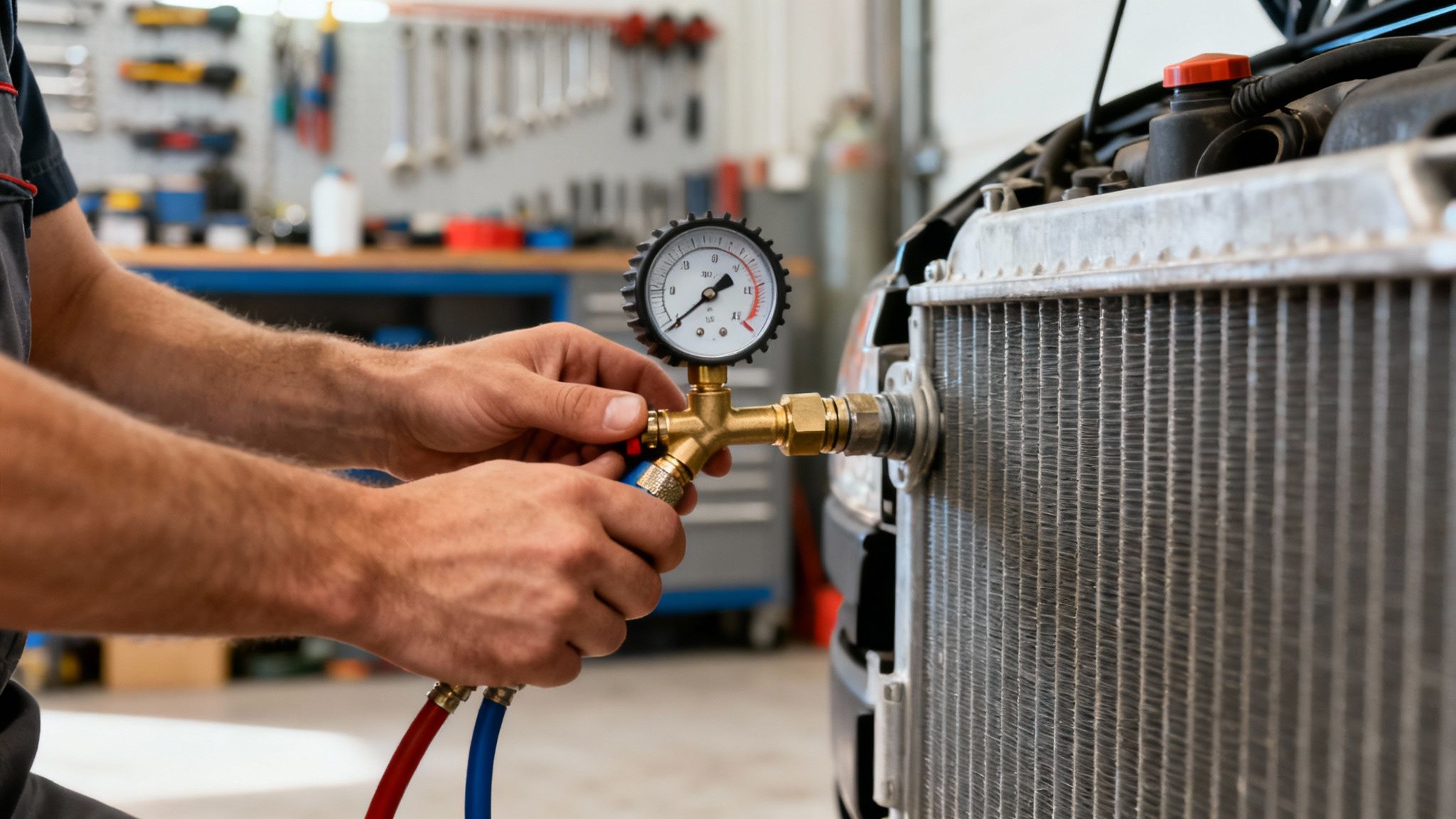
One of our go-to tools is the cooling system pressure tester. We hook it up to your coolant reservoir and bring the system up to the pressure it's designed to run at. If that pressure starts to drop, we know there’s a leak somewhere. It’s great for spotting obvious external drips, but it’s absolutely vital for flagging those sneaky internal leaks you just can't see.
Then there's the chemical block test, sometimes called a "sniff test." This is the classic, foolproof way to confirm a head gasket failure or a cracked cylinder head.
- We use a special bit of kit containing a blue chemical liquid and place it over the opening of the coolant tank.
- With the engine running, the device draws a sample of the gasses sitting on top of the coolant.
- If any exhaust fumes are getting into the cooling system, they'll react with the liquid, changing its colour from blue to yellow or green.
This simple chemical reaction is a dead giveaway. It’s the undeniable proof we need to confirm that combustion gasses are contaminating your coolant, pointing straight to a serious internal breach in the engine.
Understanding Repair Costs
Once we've pinpointed the exact problem, we'll give you a clear, straightforward quote. The final cost really depends on what's failed and the make and model of your car.
- Blown Head Gasket: This is a big job because of the sheer amount of labour involved. You could be looking at a bill anywhere from £500 to over £1,500.
- Cracked Cylinder Head: This is even more serious. The head itself will need to be professionally reconditioned or replaced entirely, meaning costs can easily climb past £2,000.
Those numbers can be a shock, but putting the repair off will always lead to a much bigger bill down the line. It's worth remembering that cooling system failures are a major cause of breakdowns, accounting for about 8% of all roadside assistance callouts in the UK recently. Diesel engines, in particular, can be prone to this due to the higher thermal stresses they operate under. You can read more about common breakdown causes on RAC.co.uk.
Here at Gladstone, we make sure you understand exactly what needs doing and why before we pick up a single spanner. Our experience in professional car diagnostics in York means we find the fault accurately and fix it right the first time, giving you complete peace of mind.
Why Choose Gladstone Tyres and Autocare?
Seeing a plume of white smoke billowing from your exhaust is a genuinely stressful moment. Your mind immediately jumps to the worst-case scenario and the potential repair bills. In situations like this, you don't just need a mechanic; you need a team you can trust to give you straight answers and quality workmanship.
That's where we come in. At Gladstone Tyres & Autocare, we've built our reputation on honest, expert-level diagnostics. Our technicians have seen it all, and we don't rely on guesswork. We use advanced diagnostic tools to get to the heart of the problem, whether it’s a tricky head gasket failure, a cracked cylinder head, or something else entirely. Pinpointing the exact cause means we fix what's actually broken, saving you time and money.
Taking the Hassle Out of a Serious Problem
We know that if you suspect a serious engine fault, the last thing you should be doing is driving your car. Pushing on with a potential coolant leak risks turning a significant problem into a catastrophic one. That's why we've built our service around your safety and convenience.
- Simple Online Booking: You can get your car booked in for a diagnostic check in just a few clicks on our website, any time of day or night.
- Collection & Delivery Service: If you're within 10 miles of our garage, we can come to you. Our collection and delivery service means you don't have to risk driving a potentially damaged vehicle. We'll handle the logistics so you don't have to.
When you hand over your keys, you’re placing your trust in us. We take that seriously. Our entire focus is on giving you peace of mind with clear communication, professional service, and a commitment to getting you back on the road safely.
With Gladstone Tyres & Autocare, you can be sure your vehicle is in skilled hands. We deliver main-dealer standards of work without the intimidating price tag, making us the go-to choice for drivers all over York.
Your Top Questions About Exhaust Smoke Answered
It's natural to have questions when your car starts acting up. Let's tackle some of the most common queries we get about white smoke coming from the exhaust, giving you the clear, straightforward answers you need.
Can Low Oil Cause White Smoke from My Exhaust?
It's a common thought, but no, low oil levels won't cause white smoke. If your engine is burning oil, usually due to things like worn piston rings, you'll see a very different kind of smoke. It’ll be a distinct blue or grey colour and have a strong, burnt smell.
White smoke is almost always about moisture. The real question is whether it's harmless water vapour or something more serious like a coolant leak.
Is It Safe to Drive with White Exhaust Smoke?
That really depends on what's causing it. If it's just a bit of thin, wispy smoke that vanishes after your car has been running for a few minutes on a chilly morning, you're fine. That’s just condensation burning off, and it's completely normal.
However, if you're dealing with thick, persistent clouds of sweet-smelling white smoke, you need to stop driving immediately. Pushing on could cause the engine to overheat catastrophically, leading to incredibly expensive damage like a warped cylinder head or even a cracked engine block. Pull over somewhere safe and call for a recovery service.
Does White Smoke Always Mean a Blown Head Gasket?
A blown head gasket is definitely the usual suspect when you see thick white smoke, but it's not the only possibility. A few other problems can cause coolant to leak into the combustion chamber and create the same effect.
These include:
- A cracked cylinder head
- A cracked engine block
- A faulty intake manifold gasket
Because several issues can produce the same symptom, getting a proper diagnostic check is crucial. It’s the only way to be certain what the problem is, making sure you only pay to fix what’s actually broken.
If you're seeing that persistent white smoke and need an expert opinion, don't just guess. The experienced technicians at Gladstone Tyres & Autocare have the diagnostic tools to find the root cause quickly and accurately. Book your diagnostic check online today or give us a call to sort out our handy vehicle collection service.
Article created using Outrank