Introduction
Receiving your MOT test results can sometimes be confusing, especially if you’ve been given an advisory notice or your vehicle has failed the inspection. Many drivers are unsure about the difference between an MOT advisory and an MOT fail, what each result means, and whether they can continue driving legally.
Understanding the distinction is important because advisory items often indicate early signs of wear, while an MOT failure means your vehicle no longer meets the minimum road safety or environmental standards required by law.
In this guide, we’ll explain MOT advisory vs fail, the different MOT defect categories, what happens after your MOT test, and when repairs should be carried out. We’ll also share practical advice to help you reduce the chances of receiving advisories or failing your next MOT.
MOT Advisory vs Fail: Quick Answer
An MOT advisory means your vehicle has passed its MOT test but has components showing signs of wear that may need attention soon.
An MOT fail means your vehicle does not meet the minimum DVSA safety or environmental standards. Depending on the type of defect, repairs may be required before the vehicle can legally return to the road.
Understanding the difference helps you prioritise repairs, maintain your vehicle properly and reduce the likelihood of failing future MOT tests.
What Is an MOT Advisory?
An MOT advisory is a notification issued during your MOT test to highlight components that are beginning to wear or may require attention in the near future. Advisory items do not cause your vehicle to fail the MOT, but they should not be ignored.
When an MOT tester identifies an advisory, it means the component still meets the legal minimum standard at the time of testing but could deteriorate before your next MOT.
Common MOT advisories include:
- Tyres approaching the legal tread depth limit
- Brake pads showing signs of wear
- Suspension components beginning to wear
- Slight corrosion underneath the vehicle
- Windscreen chips outside the driver’s line of vision
- Exhaust components showing surface corrosion
- Minor oil leaks
- Worn wiper blades
An advisory notice gives you the opportunity to repair these issues before they become more serious and potentially result in an MOT failure.
What Does an MOT Fail Mean?
An MOT fail means your vehicle has one or more defects that prevent it from meeting the legal road safety or environmental standards set by the DVSA.
Unlike an advisory, a failed MOT requires repairs before your vehicle can legally pass the inspection.
Depending on the severity of the defects, you may need to arrange repairs immediately before returning your vehicle for a retest.
Some common reasons vehicles fail an MOT include:
- Brake defects
- Worn tyres below the legal limit
- Faulty headlights or brake lights
- Excessive exhaust emissions
- Suspension damage
- Steering problems
- Seat belt defects
- Windscreen damage affecting visibility
- Faulty registration plates
An MOT failure does not always indicate major repair costs. Many failures involve relatively straightforward issues that can often be repaired quickly.
You can check your vehicle’s previous MOT results and advisory notices using the official GOV.UK MOT history service.
MOT Advisory vs Fail: What’s the Difference?
Although both advisory notices and MOT failures relate to the condition of your vehicle, they have very different meanings.
| MOT Advisory | MOT Fail |
|---|---|
| Vehicle passes the MOT | Vehicle fails the MOT |
| Repairs are recommended | Repairs are legally required before passing |
| Vehicle remains road legal (provided no dangerous defects exist) | Vehicle cannot pass until defects are repaired |
| No retest required | Retest usually required |
| Helps plan future maintenance | Immediate repairs may be necessary |
The key difference is that an advisory highlights potential future problems, while an MOT fail identifies issues that already affect the vehicle’s safety or legality.
MOT Defect Categories Explained
Since 2018, MOT defects have been divided into four categories.
Dangerous Defects
Dangerous defects represent an immediate safety risk.
Examples include:
- Severely worn tyres
- Dangerous brake faults
- Steering likely to fail
- Serious suspension damage
- Fuel leaks
Vehicles with dangerous defects should not be driven until repaired.
Major Defects
Major defects cause an MOT failure.
Examples include:
- Brake imbalance
- Faulty lights
- Worn tyres below legal tread depth
- Excessive emissions
- Suspension wear
These defects must be repaired before the vehicle can pass its MOT.
Minor Defects
Minor defects do not cause the vehicle to fail but should be repaired when practical.
Examples include:
- Slight component wear
- Small fluid leaks
- Early corrosion
Advisory Items
Advisories are observations rather than defects.
They alert the driver to components that may need attention before the next MOT but currently meet legal requirements.
Can You Drive With an MOT Advisory?
One of the most common questions motorists ask is whether they can continue driving after receiving an advisory notice.
The simple answer is yes.
An MOT advisory does not mean your vehicle has failed the inspection. It simply highlights components that may require attention before your next MOT. As long as your vehicle has passed the MOT and does not have any dangerous defects, you can continue driving legally.
However, this does not mean advisory items should be ignored. Many advisories relate to parts that are already showing signs of wear and could become unsafe if left unattended.
For example, tyres that receive an advisory because they are close to the legal tread limit may require replacement much sooner than you expect, particularly if you drive regularly or in poor weather conditions.
Ignoring advisory items can often lead to more expensive repairs later and may increase the likelihood of failing your next MOT.
Can You Drive If Your Car Fails Its MOT?
Whether you can legally drive after an MOT failure depends on the type of defect identified.
If your vehicle has received a Dangerous Defect, it should not be driven until the necessary repairs have been completed. Driving a vehicle with dangerous defects could put you and other road users at risk and may also invalidate your insurance.
If your vehicle has a Major Defect, the situation is different. In certain circumstances, you may legally drive the vehicle to a pre-booked repair appointment or another MOT test, provided it remains roadworthy. However, if the condition of the vehicle makes it unsafe, it should not be driven.
If you are unsure whether your vehicle is safe to drive after an MOT failure, always seek professional advice before using it on public roads.
Should You Repair MOT Advisories Immediately?
Although advisory notices are not legal failures, repairing them sooner rather than later is often the most cost-effective option.
Many vehicle components naturally wear over time. Addressing small issues before they become major defects can reduce repair costs, improve reliability and increase your chances of passing your next MOT without additional work.
Prompt repairs can also improve:
- Road safety
- Vehicle handling
- Fuel efficiency
- Braking performance
- Overall reliability
Regular maintenance also helps protect the value of your vehicle by preventing unnecessary mechanical wear.
Most Common MOT Advisories
Certain advisory items appear far more frequently than others during MOT inspections.
Tyres Near the Legal Limit
Tyres are one of the most common advisory items.
Although the legal minimum tread depth is 1.6mm, many MOT testers advise replacement once tyres approach this limit to maintain safe grip, especially in wet conditions.
Brake Wear
Brake pads and brake discs naturally wear over time.
If they still meet the minimum standard, they may receive an advisory rather than causing an immediate MOT failure.
Replacing worn brake components early can improve stopping distances and help prevent more expensive repairs later.
Suspension Wear
Suspension components such as bushes, ball joints and shock absorbers gradually deteriorate with mileage.
Early signs of wear often receive advisory notices before developing into major MOT defects.
Exhaust Corrosion
Surface corrosion on the exhaust system is another common advisory.
Although it may not currently affect safety or emissions, continued corrosion can eventually lead to leaks, increased emissions and MOT failure.
Windscreen Wipers
Wiper blades are inexpensive to replace but are frequently highlighted during MOT inspections.
If the blades no longer clear the windscreen effectively, replacing them before the next MOT is strongly recommended.
Battery Condition
Although the battery itself is not extensively tested during an MOT, loose mountings or visible issues may receive advisory notes.
Regular battery checks can help avoid unexpected breakdowns.
What Happens If You Ignore MOT Advisories?
Ignoring advisory items may not cause immediate problems, but it significantly increases the risk of future MOT failures.
Components naturally continue to wear during normal driving. What starts as an advisory today could easily become a major or dangerous defect before your next MOT.
Ignoring advisories may lead to:
- Increased repair costs
- Reduced vehicle safety
- Lower fuel efficiency
- Unexpected breakdowns
- Failed MOT next year
- Additional labour costs
Routine servicing and regular vehicle inspections help identify these issues before they become more serious.
How to Avoid MOT Advisories
The best way to reduce advisory notices is through regular maintenance rather than waiting until your annual MOT.
Simple checks throughout the year can make a significant difference.
Inspect Your Tyres Regularly
Check:
- Tread depth
- Tyre pressures
- Sidewall condition
- Uneven wear
Replacing tyres before they reach the legal limit helps improve safety and reduces advisory notices.
Replace Worn Wiper Blades
If your wipers leave streaks or fail to clear rain properly, replace them before your MOT.
Check All Vehicle Lights
Inspect your:
- Headlights
- Brake lights
- Indicators
- Number plate lights
- Fog lights
Faulty bulbs remain one of the easiest advisory items to avoid.
Service Your Vehicle Every Year
Routine servicing helps identify worn brakes, suspension components and other mechanical issues before they develop into MOT failures.
Many drivers combine their annual service with their MOT for added convenience.
Book an MOT Early
Booking your MOT up to one month before the expiry date gives you more time to arrange repairs if any issues are identified.
It also helps avoid driving with an expired MOT certificate.
Listen to Your Vehicle
Don’t ignore unusual noises, vibrations or warning lights.
Early diagnosis often prevents minor issues from becoming expensive repairs.
MOT Advisory vs Fail: Which Is More Serious?
When comparing an MOT advisory vs fail, it’s important to understand that they represent two very different outcomes.
An advisory is a recommendation that highlights parts showing signs of wear but still meeting the legal minimum standard. It gives you the opportunity to plan repairs before the issue becomes more serious.
An MOT fail, however, means your vehicle no longer meets the required safety or environmental standards. Repairs must be completed before the vehicle can pass the inspection and, depending on the type of defect, it may not be safe or legal to drive.
The table below summarises the key differences.
| MOT Advisory | MOT Fail |
|---|---|
| Vehicle passes the MOT | Vehicle fails the MOT |
| Repairs recommended | Repairs required |
| No immediate legal restriction | Vehicle may not be roadworthy |
| No retest required | Retest usually required |
| Helps plan future maintenance | Immediate action often required |
Understanding this difference allows drivers to make informed decisions about vehicle maintenance and avoid unnecessary repair costs in the future.
Expert Tips to Reduce the Risk of MOT Advisories and Failures
Keeping your vehicle in good condition throughout the year is the easiest way to improve your chances of passing the MOT first time.
Here are a few practical tips our technicians recommend:
Schedule Regular Vehicle Servicing
Routine servicing helps identify worn components before they become advisory items or major defects.
Many brake, suspension and steering problems can be repaired early, reducing repair costs and preventing MOT failures.
Don’t Ignore Warning Lights
Dashboard warning lights often indicate problems that may affect your MOT result.
If an engine management light, ABS light or airbag warning light appears, arrange professional diagnostics before your MOT appointment.
Inspect Your Brakes
Brakes remain one of the leading causes of MOT failures.
If you notice squeaking, grinding, vibration or longer stopping distances, have your braking system inspected as soon as possible.
Check Your Vehicle Monthly
A quick monthly inspection can identify many common MOT issues before they become expensive repairs.
Check:
- Tyre tread depth
- Tyre pressures
- Exterior lights
- Windscreen wipers
- Fluid levels
- Windscreen condition
- Registration plates
Spending just a few minutes each month can significantly reduce the risk of receiving advisory notices.
Why Choose Gladstone Tyres & Autocare?
If your MOT is approaching or you’ve recently received an advisory notice, choosing the right garage can make all the difference.
At Gladstone Tyres & Autocare, our experienced technicians provide professional Car MOT in York for petrol, diesel, hybrid and electric vehicles using DVSA-approved testing procedures.
Drivers choose us because we offer:
- DVSA-approved MOT testing
- Honest advice with no unnecessary repairs
- Experienced MOT testers
- Competitive pricing
- Modern diagnostic equipment
- MOT repairs and servicing under one roof
- Fast appointment availability
- Friendly local customer service
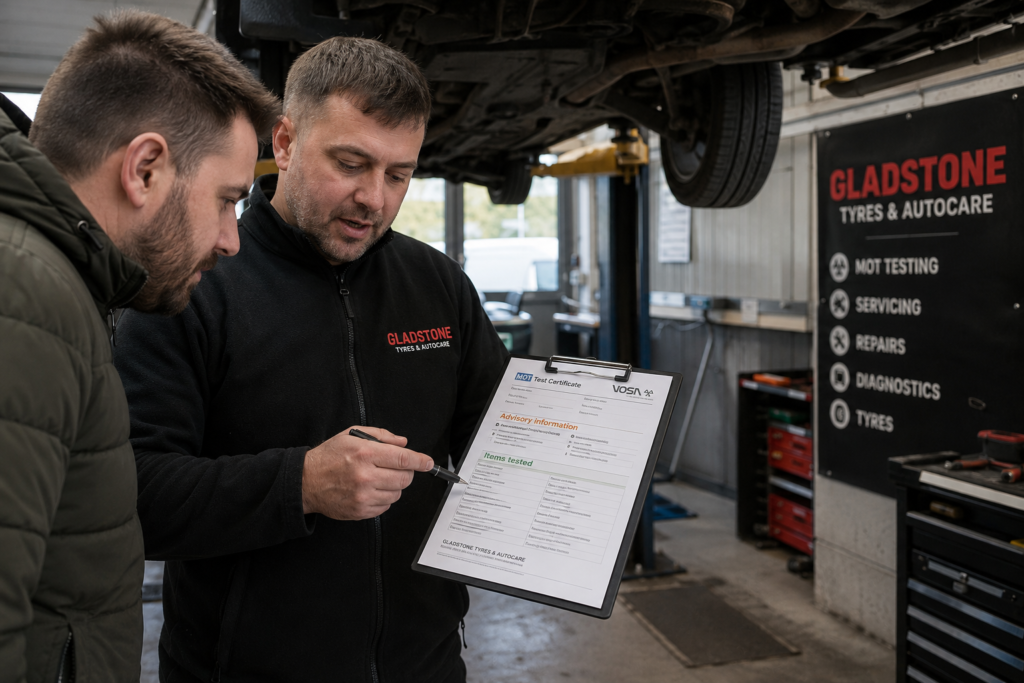
Whether your vehicle passes first time or requires repairs, we’ll clearly explain the results and recommend the most suitable solution.
Frequently Asked Questions
Is an MOT advisory a fail?
No.
An advisory is not an MOT failure. It simply highlights components that may require attention in the future but currently meet the legal standard.
Can I ignore an MOT advisory?
Although you can legally drive with an advisory in most cases, ignoring it may result in more expensive repairs or an MOT failure during your next inspection.
Can an advisory become an MOT failure?
Yes.
Components naturally wear over time. An advisory issued this year may become a major or dangerous defect by the time of your next MOT if left unrepaired.
Do MOT advisories affect insurance?
Advisories do not usually affect your insurance directly. However, if an advisory relates to a serious safety issue that is ignored and contributes to an accident, it could potentially cause complications.
Can I sell a car with MOT advisories?
Yes.
Many used vehicles are sold with advisory notices. However, repairing advisory items before selling the vehicle can increase buyer confidence and improve resale value.
How long do MOT advisories stay on record?
Advisories remain part of your vehicle’s MOT history and can be viewed using the official GOV.UK MOT history service.
Should I repair advisories before my next MOT?
Yes.
Repairing advisory items before your next MOT helps improve road safety, reduces repair costs and increases the likelihood of passing the inspection first time.
Final Thoughts
Understanding the difference between an MOT advisory vs fail helps you make informed decisions about maintaining your vehicle.
An advisory isn’t a reason to panic, but it shouldn’t be ignored. Addressing small issues early can improve your vehicle’s reliability, reduce long-term repair costs and help you avoid unnecessary MOT failures in the future.
Regular servicing, routine inspections and prompt repairs are the best ways to keep your vehicle safe, roadworthy and compliant with DVSA standards.
If your MOT is due soon or you’d like professional advice about an advisory notice, the experienced team at Gladstone Tyres & Autocare is here to help.
Book Your Car MOT in York Today
Looking for reliable MOT testing from a trusted local garage?
Gladstone Tyres & Autocare provides professional Car MOT in York for all makes and models. Our DVSA-approved technicians carry out thorough inspections, explain advisory notices clearly and offer honest recommendations without unnecessary upselling.
Whether you need an MOT, routine servicing or repairs following a failed inspection, we’re here to keep your vehicle safe, reliable and roadworthy.