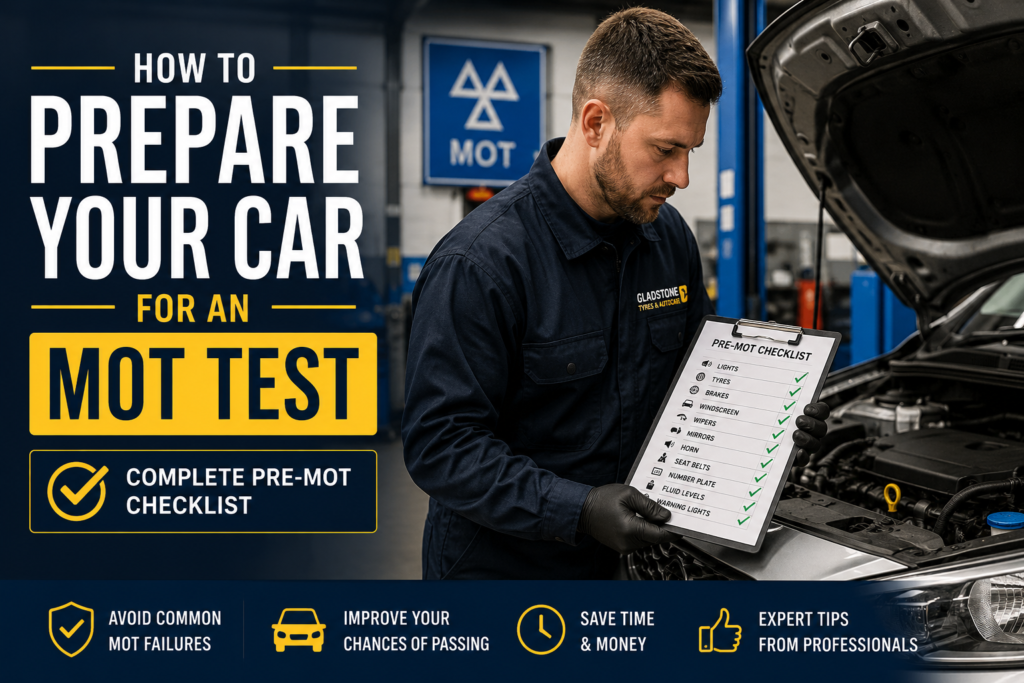
Preparing your vehicle before its annual MOT inspection can significantly improve your chances of passing first time. While an MOT test is designed to assess whether your vehicle meets the minimum legal safety and environmental standards, many cars fail because of simple issues that could have been identified and fixed beforehand.
Knowing how to prepare your car for an MOT test doesn’t require advanced mechanical knowledge. Spending just 20 to 30 minutes carrying out a few basic checks could save you time, money and the inconvenience of arranging repairs and a retest.
In this guide, we’ll explain exactly how to prepare your vehicle before its MOT, provide a practical pre-MOT checklist, highlight the most common reasons for failure and share expert tips to help you avoid unnecessary problems.
Whether you’re preparing for your first MOT or simply want to improve your chances of passing, this checklist will help ensure your vehicle is ready for inspection.
| Pre-MOT Check | Why It Matters |
|---|---|
| Lights | Faulty lights are a common MOT failure. |
| Tyres | Must have at least 1.6mm tread depth. |
| Brakes | Worn brakes can result in a major defect. |
| Wipers | Essential for clear visibility. |
| Windscreen | Cracks may cause an MOT failure. |
| Seat Belts | Must operate correctly and securely. |
| Warning Lights | Some illuminated warning lights can lead to failure. |
Quick Answer: How to Prepare Your Car for an MOT Test
The easiest way to prepare your car for an MOT test is to inspect the key safety components before your appointment.
Check that:
- All lights are working correctly.
- Tyres meet the legal tread depth.
- Windscreen wipers clean the screen effectively.
- Washer fluid is topped up.
- The horn operates correctly.
- Seat belts function properly.
- Number plates are clean and easy to read.
- There are no dashboard warning lights.
- Mirrors are secure and undamaged.
- The vehicle is generally clean and safe to inspect.
Although these checks won’t guarantee your vehicle will pass, they can help prevent many avoidable MOT failures.
Why Preparing for an MOT Is Important
An MOT test is a legal requirement for most vehicles over three years old, but it’s also an important opportunity to identify safety issues before they become more serious.
Many MOT failures are caused by relatively simple faults such as blown bulbs, worn wiper blades or tyres below the legal tread limit. These are inexpensive to fix but can still result in a failed MOT if left unresolved.
Preparing your vehicle before the inspection offers several benefits:
- Improves your chances of passing first time.
- Reduces the likelihood of unexpected repair costs.
- Helps identify worn components early.
- Saves time by avoiding unnecessary retests.
- Improves road safety for you and other road users.
A few simple checks before your MOT appointment can make the inspection smoother and give you greater confidence in your vehicle’s condition.
Before booking your appointment, you can review the official GOV.UK MOT guidance to understand the current testing requirements and when your vehicle needs an MOT.
Complete Pre-MOT Checklist: How to Prepare Your Car for an MOT Test
Before taking your vehicle to the garage, work through the following checklist.
Many of these inspections only take a few minutes but could help you avoid an MOT failure.
1. Check All Exterior Lights
Faulty lights remain one of the most common reasons vehicles fail an MOT.
Walk around your vehicle and check that every light operates correctly, including:
- Headlights
- Main beam
- Dipped beam
- Brake lights
- Indicators
- Hazard lights
- Rear lights
- Fog lights
- Number plate lights
- Reverse lights (where fitted)
Ask someone to help you check the brake lights or reverse the vehicle close to a reflective surface so you can confirm they’re working.
Replacing a faulty bulb before your MOT is usually quick, inexpensive and can prevent an unnecessary failure.
2. Inspect Your Tyres
Tyres play a vital role in vehicle safety and are carefully inspected during every MOT.
Check:
- Tread depth
- Uneven tyre wear
- Sidewall cuts
- Bulges
- Embedded objects
- Tyre pressures
The legal minimum tread depth in the UK is 1.6mm across the central three-quarters of the tyre.
Although tyres may still be legal at this limit, replacing them earlier can improve grip, braking performance and overall safety, particularly in wet weather.
If you’re unsure about the condition of your tyres, have them inspected by a qualified technician before your MOT appointment.
3. Test Your Brakes
Your braking system is one of the most important parts of the MOT inspection.
Before your MOT, pay attention to how the brakes feel while driving.
Common warning signs include:
- Squeaking or grinding noises
- Longer stopping distances
- Brake pedal vibration
- Vehicle pulling to one side
- Soft brake pedal
If you notice any of these symptoms, arrange a professional inspection before your MOT.
Replacing worn brake pads early is often much more affordable than waiting until additional components become damaged.
4. Top Up Windscreen Washer Fluid
It may seem like a small detail, but an empty washer bottle can result in an MOT failure.
Make sure:
- Washer fluid is topped up.
- Washers spray correctly.
- Jets are not blocked.
Keeping your windscreen clean improves visibility and helps ensure the tester can carry out the inspection safely.
5. Check Windscreen Wipers
Worn wiper blades reduce visibility during rain and are frequently highlighted during MOT inspections.
Inspect the rubber blades for:
- Splits
- Cracks
- Missing sections
- Streaking
- Poor contact with the windscreen
If your wipers leave streaks or fail to clear water effectively, replace them before your MOT.
Wiper blades are inexpensive and only take a few minutes to change.
6. Inspect Your Windscreen
Carefully examine your windscreen for:
- Chips
- Cracks
- Damage affecting visibility
Damage within the driver’s line of sight or beyond the permitted size limits may result in an MOT failure.
Small chips can often be repaired quickly before they develop into larger cracks requiring a full windscreen replacement.
Looking for Professional MOT Testing?
If your MOT is due soon, Gladstone Tyres & Autocare provides professional Car MOT in York for all makes and models.
Our experienced technicians carry out DVSA-approved MOT inspections, explain any advisory items clearly and provide honest recommendations without unnecessary repairs.
7. Check Your Mirrors
Your mirrors play a vital role in maintaining visibility and road safety. During an MOT inspection, the tester will ensure they are securely fitted, undamaged and provide a clear view of the road behind and beside your vehicle.
Before your MOT, inspect:
- Driver’s side mirror
- Passenger side mirror
- Rear-view mirror
- Mirror glass for cracks or damage
- Mirror adjustment mechanism
- Secure mounting
A damaged or loose mirror could result in an MOT failure if it significantly affects visibility.
8. Test Your Horn
Although it’s often overlooked, your horn is an essential safety feature and is included in every MOT inspection.
Before your appointment:
- Press the horn to ensure it works correctly.
- Check that the sound is loud and continuous.
- Make sure there are no intermittent faults.
A non-functioning horn may seem like a minor issue, but it can still result in an MOT failure.
9. Inspect Your Number Plates
Registration plates must meet legal standards regarding visibility and readability.
Before your MOT, check that your number plates are:
- Clean
- Securely attached
- Easy to read
- Free from cracks or damage
- Displaying the correct spacing and font
Dirty or damaged number plates are surprisingly common reasons for avoidable MOT failures.
10. Make Sure Seat Belts Work Properly
Seat belts are one of the most important safety components checked during an MOT.
Test every fitted seat belt by checking:
- It fastens securely.
- It locks correctly.
- It retracts smoothly.
- The buckle operates properly.
- There is no fraying or damage.
If any seat belt is damaged or fails to lock correctly, it should be repaired before your MOT appointment.
11. Check for Dashboard Warning Lights
Modern vehicles use dashboard warning lights to alert drivers to potential mechanical or safety issues.
Before your MOT, switch on the ignition and check for warning lights such as:
- Engine Management Light
- ABS Warning Light
- Airbag Warning Light
- Electronic Stability Control (ESC)
- Brake Warning Light
These warning lights can indicate faults that may affect your MOT result.
If a warning light remains illuminated after starting the engine, arrange a professional diagnostic inspection before your MOT.
12. Look for Fluid Leaks
Fluid leaks can indicate underlying mechanical issues and should never be ignored.
Inspect underneath your parked vehicle for signs of:
- Engine oil
- Coolant
- Brake fluid
- Power steering fluid
- Fuel leaks
Even small leaks may require attention before your MOT, particularly if they affect vehicle safety or emissions.
13. Remove Unnecessary Items From Your Car
Although clutter won’t usually cause an MOT failure, removing unnecessary items helps the tester carry out the inspection more efficiently.
Before your appointment:
- Empty the boot if it’s heavily loaded.
- Remove loose items from the cabin.
- Ensure the driver’s footwell is clear.
- Remove accessories that obstruct visibility.
A clean, organised vehicle also creates a positive first impression.
Common Mistakes Drivers Make Before an MOT
Many MOT failures could be avoided with a little preparation.
Some of the most common mistakes include:
Waiting Until the Last Minute
Leaving your MOT until the expiry date leaves little time to arrange repairs if your vehicle fails.
Booking your MOT early gives you more flexibility while still preserving your renewal date.
Ignoring Dashboard Warning Lights
Many drivers assume warning lights will disappear on their own.
In reality, warning lights often indicate genuine faults that should be investigated before your MOT.
Forgetting Simple Checks
Something as simple as:
- A blown bulb
- Empty washer bottle
- Worn wiper blade
- Dirty number plate
can result in an unnecessary failure.
These issues usually take only a few minutes to fix.
Ignoring Unusual Noises
Grinding brakes, suspension knocks or steering vibrations often indicate mechanical wear.
Having these issues inspected early can prevent more expensive repairs and improve your chances of passing the MOT.
Can You Carry Out Your Own Pre-MOT Inspection?
Yes.
Although you cannot perform the official MOT yourself, carrying out a basic inspection beforehand is highly recommended.
Most of the checks covered in this guide require little or no technical knowledge and can be completed at home in less than half an hour.
However, components such as brakes, suspension, steering and emissions should always be inspected by qualified technicians if you suspect a fault.
A professional pre-MOT inspection can identify issues that may not be obvious during a visual check.
Should You Service Your Car Before an MOT?
One of the questions we hear most often is whether it’s worth servicing your vehicle before its MOT.
While it’s not a legal requirement, servicing your car beforehand offers several advantages.
A routine service can identify worn components that might otherwise cause an MOT failure, including:
- Brake wear
- Suspension issues
- Fluid leaks
- Battery problems
- Engine performance concerns
Many drivers choose to combine servicing with their MOT appointment to save time and improve their chances of passing first time.
Regular servicing also helps extend the lifespan of your vehicle and reduce unexpected repair costs.
Why Booking Your MOT Early Is a Smart Decision
Many motorists don’t realise that you can book your MOT up to one month before your current certificate expires while keeping the same renewal date.
Booking early provides several benefits:
- More appointment availability
- Time to arrange repairs if required
- Less risk of driving with an expired MOT
- Greater flexibility if parts need ordering
Planning ahead removes unnecessary stress and helps ensure your vehicle remains legally roadworthy throughout the year.
Expert Tips on How to Prepare Your Car for an MOT Test
Although no garage can guarantee that a vehicle will pass its MOT, following a proactive maintenance routine can significantly improve your chances.
Here are some expert recommendations from our technicians.
Drive Your Vehicle Before the MOT
If your vehicle has been parked for an extended period, take it for a short drive before your appointment.
This can help:
- Charge the battery
- Warm up the engine
- Improve braking performance
- Clear light surface rust from the brake discs
- Allow diesel vehicles to complete a regeneration cycle where applicable
Driving your vehicle beforehand also gives you the opportunity to identify any unusual noises or warning lights that may require attention.
Keep Up With Routine Servicing
Regular servicing is one of the most effective ways to reduce the likelihood of MOT failures.
Routine maintenance allows worn components to be identified and replaced before they become major defects.
A professional service can identify issues affecting:
- Brakes
- Suspension
- Steering
- Tyres
- Fluids
- Battery
- Exhaust system
Keeping your vehicle serviced throughout the year is often more cost-effective than repairing multiple faults after a failed MOT.
Don’t Ignore Warning Signs
Your vehicle will often give you early warning signs before something fails completely.
Pay attention to:
- Unusual noises
- Vibrations
- Warning lights
- Poor braking performance
- Uneven tyre wear
- Steering pulling to one side
- Reduced engine performance
Addressing these issues early can improve safety and increase your chances of passing the MOT.
Choose a Trusted MOT Testing Centre
Selecting a reputable garage ensures your vehicle is inspected by qualified technicians following DVSA-approved testing procedures.
An experienced MOT tester will explain any advisory items clearly and provide honest recommendations if repairs are required.
Why Choose Gladstone Tyres & Autocare?
If you’re looking for reliable Car MOT in York, Gladstone Tyres & Autocare provides professional MOT testing for all makes and models.
Our experienced technicians carry out thorough DVSA-approved inspections and provide clear, honest advice without unnecessary upselling.
When you choose Gladstone Tyres & Autocare, you benefit from:
- DVSA-approved MOT testing
- Experienced and qualified technicians
- Transparent pricing
- Honest repair recommendations
- Modern diagnostic equipment
- Fast appointment availability
- Servicing and repairs under one roof
- Friendly local customer service
Whether your MOT is due next week or you’ve already identified a potential issue, we’re here to help keep your vehicle safe, reliable and roadworthy.
Frequently Asked Questions About How to Prepare Your Car for an MOT Test
How can I prepare my car for an MOT test?
The best way to prepare your car is by checking your lights, tyres, brakes, windscreen wipers, mirrors, horn, seat belts, number plates and dashboard warning lights before your appointment. Fixing small issues in advance can help improve your chances of passing.
What should I check before an MOT?
Before your MOT, inspect:
- Exterior lights
- Tyres
- Brake performance
- Windscreen
- Wiper blades
- Washer fluid
- Mirrors
- Seat belts
- Number plates
- Dashboard warning lights
These simple checks can help prevent avoidable MOT failures.
Will a dirty car fail an MOT?
A dirty vehicle will not normally fail an MOT. However, excessively dirty registration plates, mirrors or windscreens that affect visibility or identification could cause problems during the inspection.
Should I service my car before an MOT?
Although not mandatory, servicing your vehicle before its MOT is highly recommended. A service can identify worn components and mechanical issues that might otherwise result in an MOT failure.
Can I carry out my own pre-MOT inspection?
Yes. Many basic checks, such as inspecting lights, tyres, washer fluid and wiper blades, can be completed at home. However, brakes, suspension and steering should be inspected by a qualified technician if you suspect any faults.
What is the most common reason for MOT failure?
The most common reasons include worn tyres, faulty lights, brake defects, suspension wear and excessive emissions. Most of these issues can be identified and repaired before the MOT with regular maintenance.
Does preparing my car guarantee it will pass?
No. While preparing your car significantly reduces the risk of avoidable failures, the final result depends on the overall condition of the vehicle and the findings of the official DVSA inspection.
Final Thoughts on How to Prepare Your Car for an MOT Test
Knowing how to prepare your car for an MOT test is one of the simplest ways to improve your chances of passing first time.
Most MOT failures are caused by issues that develop gradually and can often be identified before the inspection with a few straightforward checks. By following this pre-MOT checklist, keeping your vehicle regularly serviced and addressing warning signs promptly, you can reduce repair costs, improve safety and avoid unnecessary inconvenience.
Whether you’re preparing for your annual MOT or simply want peace of mind before booking your appointment, taking a proactive approach to vehicle maintenance is always worthwhile.
Book Your Car MOT in York Today
If your MOT is due soon, book your Car MOT in York with Gladstone Tyres & Autocare.
Our experienced technicians provide professional DVSA-approved MOT testing, honest advice and reliable vehicle care for drivers across York and the surrounding areas.
We also offer:
- Car Servicing in York
- Brake Repairs in York
- Vehicle Diagnostics in York
- Wheel Alignment in York
- Tyre Replacement in York
Contact our team today to arrange your MOT appointment and keep your vehicle safe, roadworthy and ready for the year ahead.