That sudden, unwelcome amber glow on your dashboard can certainly put a damper on your day. One minute you're driving along, the next you're faced with that little engine symbol, turning a normal trip into a moment of doubt. It’s your car’s way of tapping you on the shoulder and saying, “Hey, something’s not quite right under the bonnet.”
But don't panic. Think of the engine warning light as a message, not a catastrophe. It means your vehicle's computer has flagged a potential issue with the engine, transmission, or emissions system. Your first job is to stay calm and figure out how serious it is, and that all comes down to one simple thing: is the light steady or is it flashing?
Your First Steps When the Engine Warning Light Appears
Your top priority is always safety—for you, your passengers, and everyone else on the road. The way the light behaves will tell you exactly what you need to do next.
A steady light is a heads-up. It's letting you know a fault has been registered, but it’s not an immediate emergency. A flashing light, on the other hand, is a different story entirely. That’s an urgent alert for a severe problem that could cause serious, and often very expensive, damage if you keep driving.
Steady vs Flashing Light: What to Do
Let's break down what each signal means for you.
- Steady Light: This is a non-critical warning. You can usually carry on with your journey, but you shouldn't ignore it. The best thing to do is book a diagnostic check with a trusted garage as soon as you can.
- Flashing Light: This is your car's version of a red alert. A blinking light often signals a major engine misfire. If you ignore it, you risk destroying your catalytic converter—a repair that can run into the hundreds, if not thousands, of pounds. Pull over somewhere safe as soon as you can, switch off the engine, and call for breakdown assistance.
This simple decision tree can help you visualise the right course of action.
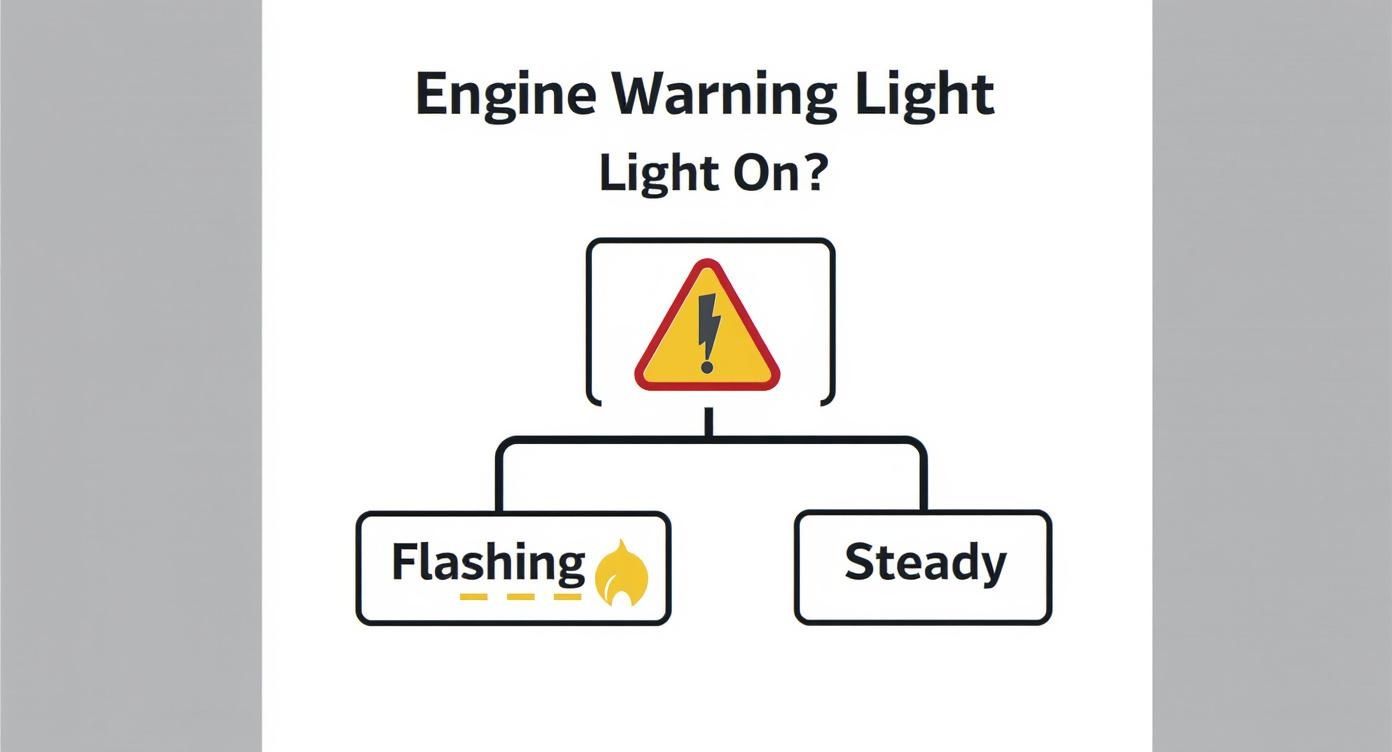
The message is clear: a flashing light means stop immediately, while a steady one gives you time to get it checked professionally.
Check for Other Symptoms
The warning light is just one piece of the puzzle. Pay close attention to how your car is actually feeling and sounding. Are there any other tell-tale signs something is wrong? These clues can help paint a clearer picture of what's going on.
An engine warning light is your car's first line of communication. Listening to other signs, like strange noises or reduced power, helps you understand the full story and react appropriately to keep both your vehicle and yourself safe.
Keep an eye (and an ear) out for any of these accompanying symptoms:
- A noticeable loss of power, making the car feel sluggish.
- Unusual noises like knocking, hissing, or grinding.
- Smoke from the exhaust or under the bonnet.
- A rough, juddering sensation when the car is idling.
- The engine is suddenly difficult to start.
If you spot any of these, especially alongside a flashing light, it’s always best to play it safe. Pull over and get help.
Decoding Common Engine Warning Light Causes
Seeing that little engine symbol light up on your dash doesn't automatically mean disaster is imminent. It's simply your car's brain—the Engine Control Unit (ECU)—telling you that something needs attention. The ECU is like your car’s central command, constantly keeping an eye on dozens of sensors. If one of those sensors reports a value that’s a bit off-kilter, the ECU logs a fault code and flicks on the light to give you a heads-up.
While there's a long list of potential reasons for the light, most of the time it comes down to a handful of common culprits. Knowing what they are can help you swap that gut-sinking feeling for a clear plan.
The Most Common Triggers for an Engine Warning Light
From the incredibly simple to the more involved, here are the issues our technicians see day in and day out. Sometimes, the fix is surprisingly painless.
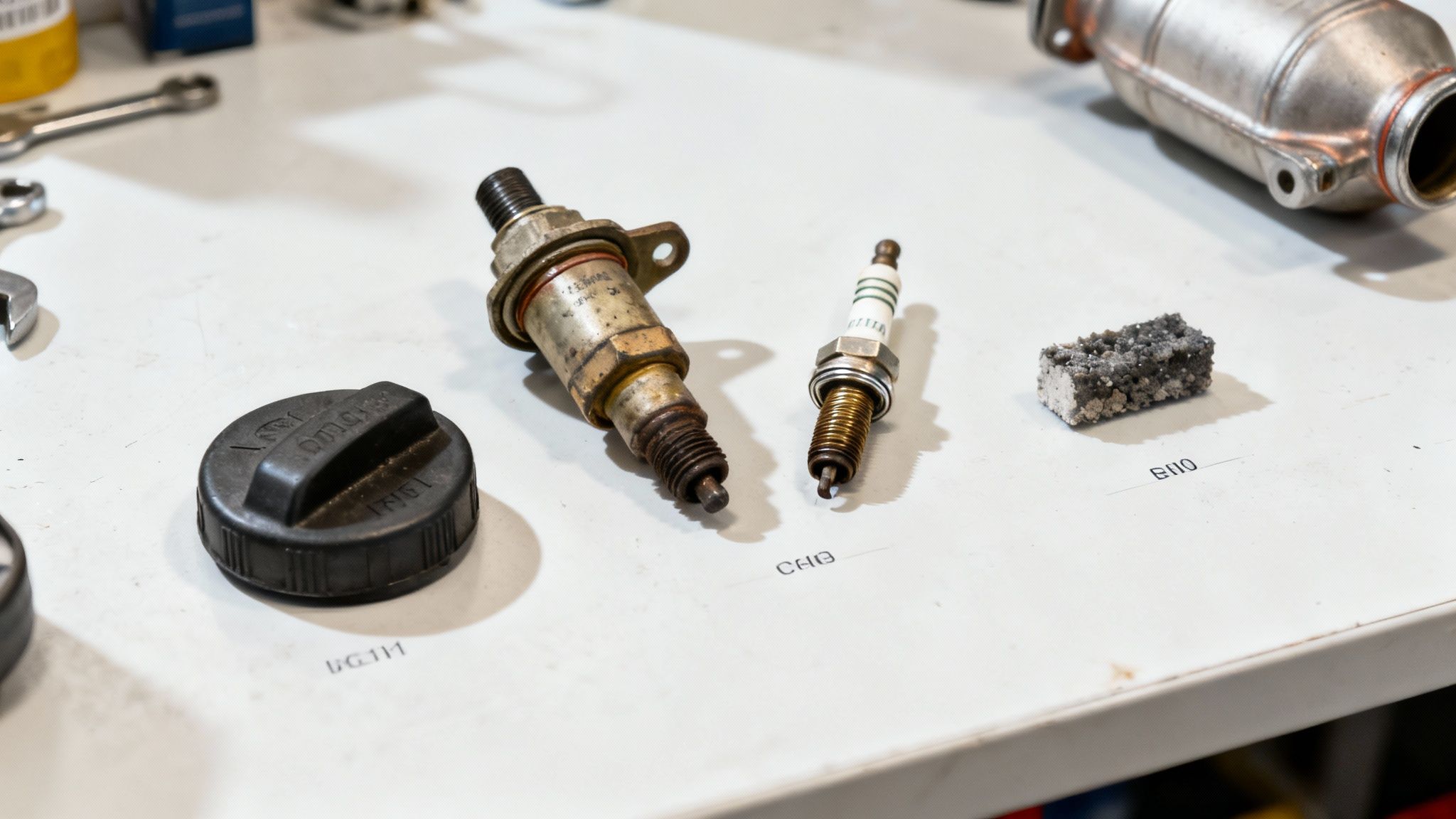
- A Loose or Faulty Fuel Cap: Honestly, this is the best-case scenario. Your fuel cap is a key part of the fuel system's vapour recovery. If it’s not screwed on tight, is cracked, or has gone missing, it creates a small leak that the ECU flags as a problem, switching on the light.
- Failing Oxygen (O2) Sensor: Think of the O2 sensor as your car’s nose, sniffing the exhaust to measure how much unburnt oxygen is present. This information is vital for the ECU to create the perfect fuel-to-air mix. When an O2 sensor starts to fail, your car often ends up burning more fuel, hitting your wallet and potentially causing more damage down the road.
- Worn-Out Spark Plugs or Ignition Coils: The spark plugs are what ignite the fuel in your engine. If they’re old and tired, they can cause a misfire, which you might feel as a stutter or hesitation when you put your foot down. This is one of the more serious faults that can cause a flashing engine light, which demands immediate attention.
Deeper System Faults
Of course, sometimes the issue lies with more critical parts of your engine and emissions system. These are problems that almost always need a professional eye.
A prime example is a problem with the catalytic converter, the component responsible for converting nasty exhaust fumes into less harmful gases. Over time, it can get clogged up with carbon or simply fail. This is often a knock-on effect from another problem, like a bad oxygen sensor that's been messing up the fuel mixture for a while. For drivers of hybrid vehicles, getting your head around how hybrid cars actually work can also shed light on unique issues that might trip the warning light.
A common misconception is that the warning light points to one specific failure. In reality, it signals that a system isn't performing correctly. A single fault code can be triggered by several different underlying problems, which is why professional diagnostics are so important.
Another common gremlin is the mass airflow sensor, which measures the amount of air being pulled into the engine. If this sensor is faulty, it feeds bad data to the ECU, leading to poor performance, rough idling, and rubbish fuel economy. Tracing these interconnected faults correctly is what we do best, and our team is fully equipped to handle comprehensive engine management diagnostics.
The Hidden Costs of Ignoring the Light
It’s tempting to adopt an "out of sight, out of mind" attitude when that little amber light pops up on your dash, especially if the car seems to be driving just fine. But putting it off is a bit like ignoring a persistent toothache – it almost never gets better on its own, and the eventual fix is usually far more painful.
What starts as a simple, relatively cheap problem can spiral into something much more serious. Take a faulty oxygen sensor, for instance. Ignoring it means your car’s brain gets bad information about the fuel-air mix. This not only hammers your fuel economy, forcing you to the pumps more often, but it can eventually ruin your catalytic converter. Suddenly, a fix that might have cost under £100 has turned into a repair bill that could easily top £1,000.
The Snowball Effect on Your Wallet and MOT
The financial hit isn’t just about the final repair bill. An engine light problem almost always means your car is running inefficiently and producing more emissions than it should, which creates a chain reaction of problems for you.
- Increased Fuel Consumption: Your car will be guzzling more petrol or diesel, so you'll be spending more just to get around.
- Poor Performance: You might feel the car hesitating when you accelerate or notice it running rough when you’re stopped. It makes driving less pleasant and can even be unsafe.
- Guaranteed MOT Failure: An illuminated engine management light is an automatic fail on your MOT. There's no getting around it. You'll have to get it fixed and pay for a re-test.
Recent research has shown just how many UK drivers are taking this gamble. A worrying 43 per cent admit to ignoring dashboard warning lights, and about 15 per cent (that's around 5.5 million people) leave them on for more than a week. It’s a risky habit, especially when you learn that nearly a third of drivers have had a breakdown or an accident that was a direct result of ignoring a warning light. You can read the full research on driver habits to see just how common this is.
Proactive Diagnosis Is the Smartest Move
When you weigh it all up, the hidden costs of ignoring your engine warning light are far greater than the price of getting it checked out promptly. You’re looking at higher fuel bills, the risk of eye-watering repair costs, and the certainty of a failed MOT.
Think of a diagnostic check not as an expense, but as an investment. It's the most effective way to protect your vehicle's health, keep running costs down, and ensure you stay safe and legal on the road.
By tackling the problem head-on, you’re choosing the cheaper, smarter path. You catch small issues before they become catastrophic failures, keeping your car reliable, efficient, and ready for the road. Don’t wait for a small alert to become a major headache.
How Professionals Diagnose the Real Problem
While it's always worth trying simple fixes like tightening the fuel cap, those DIY checks often only scratch the surface. When an engine warning light stays on, figuring out the real problem requires a combination of high-tech tools and a mechanic’s intuition, honed over years of experience.
The process starts with an On-Board Diagnostics (OBD-II) scanner. It's easy to think of this as a magic box that spits out the answer, but it’s more like a highly specialised translator. The scanner plugs into your car and communicates with its central computer—the Engine Control Unit (ECU)—to pull out a specific fault code.
This code, something like "P0420" for example, is our first big clue. It points us in the right direction, telling us which system is flagging an issue. But it’s just the start of the investigation, not the final answer.
From Code to Cause
A fault code is a symptom, not a diagnosis. That "P0420" code, for instance, points towards the catalytic converter system. A DIY approach might lead you to assume the converter itself has failed, which is an expensive guess.
In reality, the root cause could be something else entirely. Perhaps a faulty oxygen sensor is feeding the ECU bad information, or there's a small leak in the exhaust system. It could even be an engine misfire that’s been slowly damaging the converter over time. This is where a technician’s expertise really comes into play.
They use the code as a starting point for a series of targeted checks:
- Live Data Analysis: We hook up the scanner and watch the data pour in from your car's sensors in real-time. This lets us see if everything is operating within its expected range.
- Physical Inspection: There's no substitute for a good look. A technician will visually inspect all the related wiring, hoses, and components for any obvious signs of wear, tear, or damage.
- Specialised Testing: Depending on the code, we might bring out other tools. A multimeter can track down an electrical fault, while a smoke machine is brilliant for finding tiny, hidden vacuum leaks.
An OBD-II code is like a signpost pointing to a neighbourhood in a city. A professional technician is the local guide who knows all the streets and back alleys and can take you directly to the specific house where the problem lives.
The Professional Advantage
Trying to solve a persistent warning light with a basic code reader can quickly turn into an expensive and frustrating game of "parts darts," where you end up replacing perfectly good components.
To see how our experts get to the bottom of these mysteries, you can learn more about our dedicated car diagnostics in York.
Ultimately, trusting a professional means you're not just paying for a code to be read; you're investing in a definitive answer. This ensures the correct repair happens the first time, saving you the time, money, and stress of that little light popping back on. It’s simply the most reliable way to get back on the road with complete confidence in your car.
How the Engine Light Affects Your MOT Test
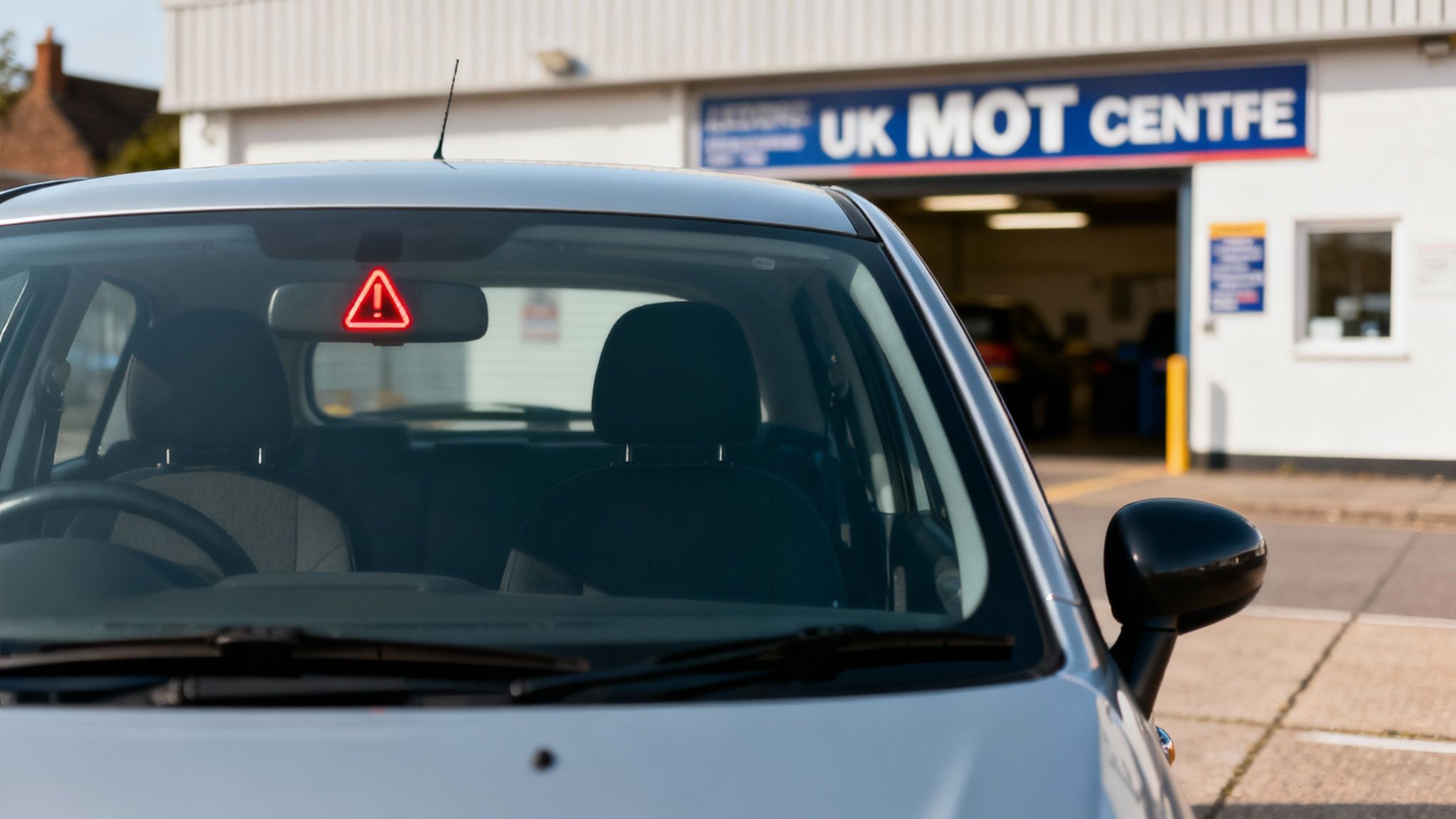
For any driver in the UK, the annual MOT test is a non-negotiable part of owning a car. It's the one day of the year where your vehicle gets a thorough once-over to make sure it's safe, roadworthy, and not harming the environment. So, when that little engine warning light decides to stay on, it can cause a big problem for your test result.
Let's cut to the chase: if your engine management light is lit up during the MOT, it's a near-guaranteed fail. This isn't just a minor note or an advisory; it's classed as a major defect. Part of the test is checking that all your dashboard lights work as they should—they need to light up when you turn the key and then switch off once the engine is running.
When that light stays on, it’s your car’s way of shouting that the Engine Control Unit (ECU) has spotted a problem in the engine or emissions system. Given the MOT's strict focus on emissions, an active light is a huge red flag for the tester, signalling that your car is probably kicking out more pollution than it’s legally allowed to.
MOT Rules and Vehicle Age
Now, this rule doesn't catch every single car on the road. There are a few exemptions based on the age and fuel type of your vehicle, which is useful to know if you're driving an older model.
An illuminated engine management light is one of the most common and clear-cut reasons for an MOT failure. Getting to the bottom of the issue before your test is the only way to be sure of a pass.
While an engine light is a common MOT stumbling block, some older cars get a pass on this particular check. Diesel vehicles first used before 1st July 2008 and petrol vehicles first used before 1st July 2003 are exempt from this rule. You can find more details on these MOT regulations on RAC.co.uk.
For any car newer than those dates, however, a glowing engine light means an automatic fail. The best thing you can do is get the fault properly diagnosed and sorted out before your appointment. This will save you the time, money, and frustration of a failed test and the inevitable re-test. Get ahead of the game by finding out more about our comprehensive MOT test services and book your vehicle in with confidence.
Let Our Gladstone Experts Get to the Bottom of It
Seeing that little light on your dashboard is one thing; figuring out what to do next is another. That’s where we come in. When your engine warning light makes an appearance, it's a clear signal to let the experienced team at Gladstone Tyres & Autocare step in and give you some clarity.
We've built our reputation on honest, straightforward car care. Our first job isn't to sell you a repair—it's to find out exactly what’s going on under the bonnet. Think of us as detectives for your car; we’re here to solve the mystery correctly, right from the start.
How We Diagnose the Problem
Our workshop is equipped with the same advanced diagnostic tools you'd find at a main dealer. Our skilled technicians plug directly into your car's computer, pulling the specific fault codes that your car has logged. But technology is only half the story. We then use our years of hands-on experience to interpret that data and physically inspect the related components to find the true source of the issue.
You'll always get a plain-English explanation of what's wrong and a clear, detailed quote for the fix. We won't touch a single spanner until you give us the thumbs-up.
There’s no sense in letting a dashboard light ruin your day. Let our team handle it with the professional, reliable service you and your car deserve, so you can get back behind the wheel feeling confident.
Ready to find out what that light really means?
- Book Online: Schedule your diagnostic check with us today
- Give Us a Call: 01904 431050
- Drop By the Garage: Outgang Lane, Osbaldwick, York, YO19 5UP
For expert service and advice you can trust, look no further than Gladstone Tyres & Autocare.
Your Questions, Answered
Even after getting the rundown on the engine warning light, it's natural to have a few more specific questions pop into your head. Here are some straightforward answers to the queries we hear most often from drivers around Gladstone.
Is It Safe to Drive with the Light On?
This really hinges on what the light itself is doing. If you've got a steady engine warning light and the car feels perfectly normal to drive, you're generally safe to get where you're going. Just make it a priority to book a diagnostic check soon.
On the other hand, a flashing light is a totally different story. That’s your car’s way of screaming for help. It means you need to pull over and stop the engine as soon as it's safe. A flashing light points to a serious engine misfire, which can wreck your catalytic converter in a matter of minutes – a very expensive fix. Don't risk it.
Why Did My Engine Light Appear After Fuelling?
We see this one all the time, and thankfully, it's often a simple fix. The prime suspect is nearly always a loose or poorly fitted fuel cap. Your fuel system is designed to be sealed and pressurised, and if the cap isn't on tight, it creates a vapour leak. The car's computer senses this and flags it with the warning light.
Next time you fill up, make sure you tighten the cap until you hear it click a few times. If the light stays on after a few more drives, then it's time to let us have a look.
Can I Just Reset the Light Myself?
Technically, yes, you can buy a basic OBD-II scanner and clear the code yourself. But we strongly advise against it. All you're doing is deleting the error message, not solving the actual problem that caused it. Think of it like silencing a smoke alarm without looking for the fire.
Resetting the engine warning light without a proper diagnosis is a risky shortcut. The fault still exists, and ignoring it can lead to more significant damage and higher repair costs later on.
The light is almost guaranteed to come back on, and in the meantime, the hidden issue could be causing serious harm to your engine or emissions system.
How Long Does a Diagnostic Check Take?
Getting to the bottom of the issue is a surprisingly quick process. Here at our Gladstone garage, we can usually plug in, read the fault codes, and run our initial checks within 30 to 60 minutes. That gives us all the information we need to tell you exactly what’s wrong and provide a clear, no-obligation quote for the repair.
Don't let a mysterious light on your dashboard ruin your day. For a fast, accurate diagnosis from a team you can trust, bring your car to Gladstone Tyres & Autocare. Book your engine diagnostic check online today and let our professionals give you the peace of mind you need.
Article created using Outrank