
It's a tiny, often-overlooked sensor, but the brake light switch is what tells your brake lights to flash on the instant your foot touches the pedal. It's a simple part doing a vital job: communicating your intention to slow down or stop to the drivers behind you. When it fails, it's not just an inconvenience—it's a serious safety risk and an automatic MOT failure.
The Tiny Switch That Protects You on the Road
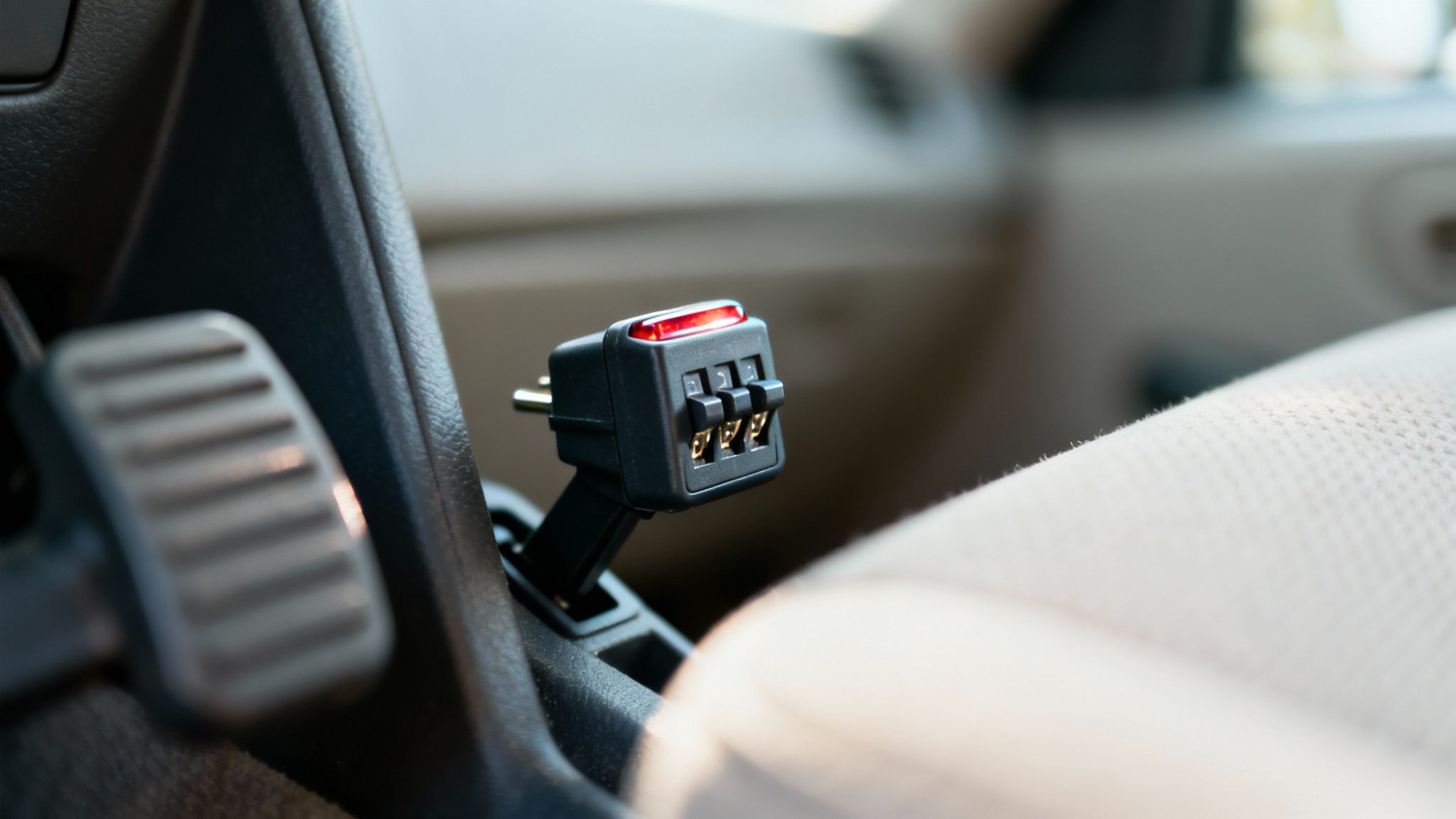
You’d probably never even notice it, but the brake light switch is one of the hardest-working safety components in your car. Think of it as the silent guardian of your braking system. It’s the trigger that instantly alerts other road users the second you start to brake, making it absolutely crucial for preventing rear-end collisions.
When this little switch gives up, the consequences can range from a frustrating MOT fail to genuinely dangerous situations on the road. That’s why keeping it in good working order is a non-negotiable part of comprehensive vehicle maintenance that protects you and everyone else.
Why This Small Part Matters So Much
The brake light switch does more than just flick on a light. In today's cars, its signal feeds into a whole network of other systems. A fault here can cause a ripple effect, leading to a host of confusing and seemingly unrelated electrical problems.
This guide will walk you through everything you need to know about this critical component. We’ll cover:
- How this simple switch works its magic.
- The tell-tale signs of failure you should never ignore.
- What's involved when it’s time to get it sorted by a professional.
By learning to spot a problem early, you're putting yourself in the driver's seat. You can keep your car safe, stay on the right side of UK road laws, and ensure everything runs as it should.
Knowing the basics helps you have a much better conversation with your mechanic and underscores why you should never put off fixing a faulty brake light switch. Let's start by looking at how this simple device gets the job done.
How a Brake Light Switch Works
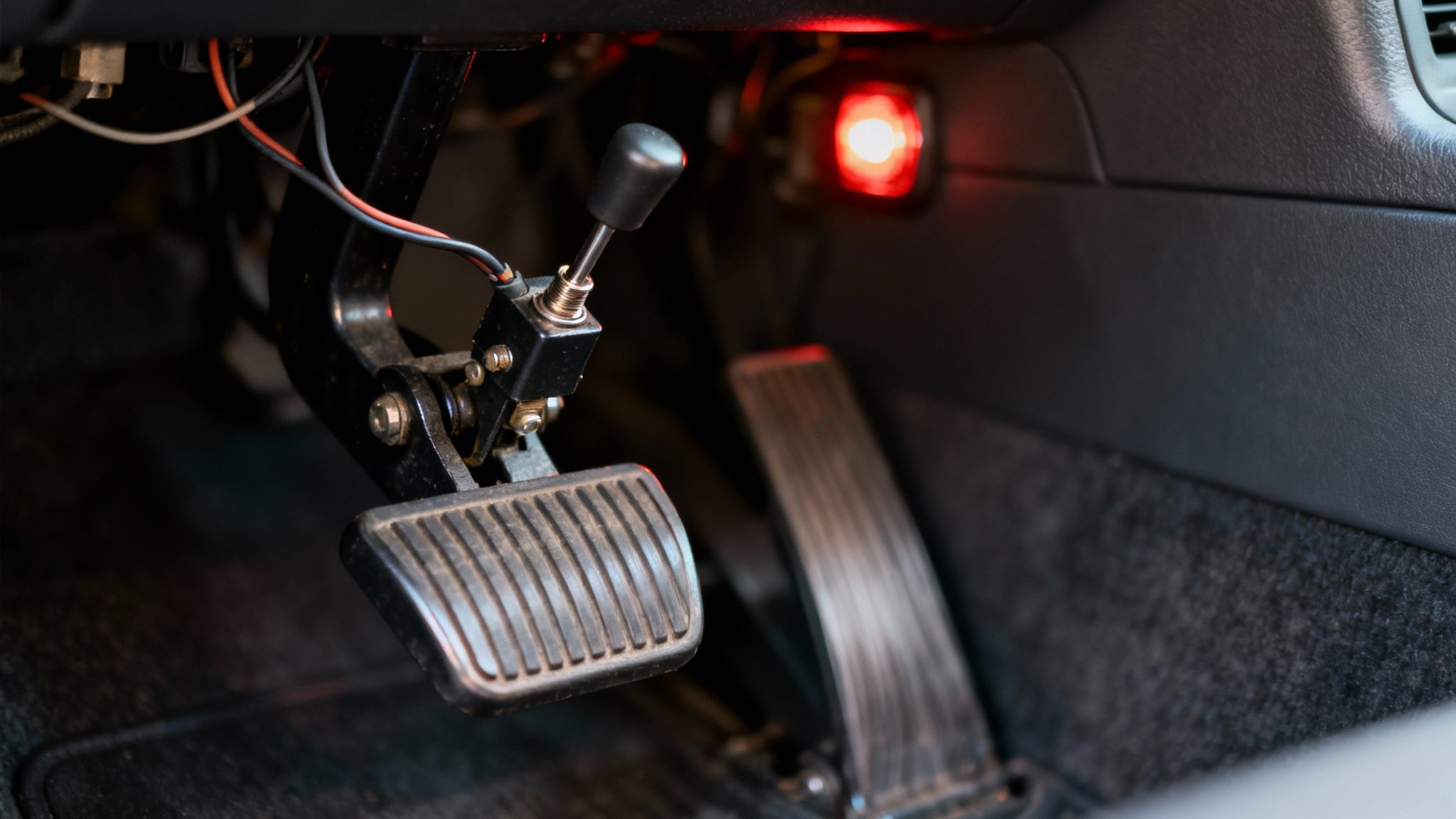
So, how does this small but vital component actually get the job done? In essence, the brake light switch is a straightforward sensor. Think of it as the first domino in a chain reaction. The moment your foot touches the brake pedal, the switch springs into action, completing an electrical circuit that sends an instant signal to your brake lights.
It’s as quick as flicking a light switch at home, but its job is far more critical for road safety. This is the primary way your car tells everyone behind you that you’re slowing down. Once you understand this simple 'on/off' mechanism, it becomes much clearer why a fault can cause such a ripple effect through your car's other systems.
The Two Main Types of Switches
While they all achieve the same goal, not all brake light switches are built the same. The vast majority of cars on the road today use a simple mechanical switch, but some older or more specialist vehicles might have a hydraulic one.
- Mechanical Switch: This is the one you’re most likely to find. It's a small plunger-style switch that sits on a bracket right by the top of the brake pedal arm. When you press the pedal, it moves away from the switch's plunger, which closes the circuit and sends the signal. Simple, effective, and reliable.
- Hydraulic Switch: You don't see these as often anymore. Instead of being triggered by the pedal's movement, this type is plumbed directly into the brake lines. It reacts to the sudden increase in brake fluid pressure when you hit the brakes.
No matter the design, the principle is identical: it detects your intention to brake and triggers an electrical response.
The standardisation of these parts didn't happen overnight. The importance of clear braking signals was formally recognised decades ago, leading to specific UK regulations to ensure every vehicle on the road met a minimum safety standard.
It’s About More Than Just Lights
In any modern car, the signal from the brake light switch is a crucial piece of data that gets shared across several on-board computers, or Electronic Control Units (ECUs). It's no longer just about lighting up a bulb; it's about communication.
This integration is exactly why a faulty switch can cause such baffling problems. Your cruise control system, for example, relies on that signal to know when you've hit the brakes so it can disengage immediately. Likewise, systems like Electronic Stability Control (ESC) and Anti-lock Brakes (ABS) use the signal as a key part of their calculations to keep you safe and in control. Even push-button start systems often won't let the engine fire up until they receive a signal confirming the brake pedal is pressed.
This is why ensuring all components related to your vehicle’s lighting systems are in perfect order is fundamental to your car’s overall health. This interconnectedness shows how much things have evolved. By the 1980s, UK laws began to strictly enforce these safety features, ensuring brake lights and their switches provided clear communication to prevent accidents on our increasingly busy roads.
Warning Signs of a Failing Brake Light Switch
When a brake light switch starts to give up the ghost, it can throw up some pretty confusing symptoms. Because this little sensor talks to so many different systems in your car, the problems can seem completely unrelated to the brakes at first glance. Recognising these signs early is the key to getting it sorted quickly and safely.
The most obvious sign, naturally, is when your brake lights start acting up. This can go one of two ways, and both are serious problems for you and other road users.
Brake Lights Not Working at All
This is, without a doubt, the most dangerous symptom. If your brake lights don't come on, the driver behind you gets no warning that you’re slowing down. That’s a recipe for a rear-end collision. It’s also an instant MOT failure and makes your car illegal to drive on UK roads.
More often than not, the culprit is a faulty contact inside the brake light switch. The switch simply isn't completing the electrical circuit when you press the pedal, so no power ever reaches the bulbs.
Brake Lights Are Stuck On
On the flip side, you might find your brake lights are stuck on, even when you've parked up and switched the engine off. This is a brilliant way to drain your battery and get stranded. It also completely confuses other drivers, as they can't tell when you're actually braking.
This usually happens when the switch's internal plunger gets stuck in the 'on' position. This creates a permanently closed circuit, sending a constant stream of power to the brake lights.
Problems with Cruise Control
Most of us take cruise control for granted, but it’s directly tied to the brake light switch. A key safety feature is that it disengages the instant you so much as breathe on the brake pedal.
If the switch is on the fritz, it might be sending a constant or intermittent 'braking' signal to the car's computer. The cruise control system sees this and, for safety's sake, refuses to engage. If your cruise control suddenly decides to pack it in, the brake light switch is a very likely suspect.
Dashboard Warning Lights Appear
A failing brake light switch can set off a Christmas tree of warning lights on your dashboard, many of which seem to have nothing to do with braking. Systems like the Anti-lock Braking System (ABS) and Traction Control System (TCS) depend on accurate information from the switch. A dodgy signal makes them think there’s a major problem.
You might see lights for:
- ABS: This light points to a fault in the anti-lock braking system.
- Traction Control/Stability Control (TCS/ESC): This indicates a problem with the system that stops your wheels from spinning.
These advanced safety systems need to know when you're braking to work correctly. A faulty switch sends conflicting data, so the car’s brain logs a fault and puts the warning light on as a precaution.
Issues Starting Your Car
If you have a car with a push-button start, the brake light switch is crucial. As a safety feature, you have to press the brake pedal before the engine will fire up. The car's computer waits for a signal from the brake light switch to confirm you’ve done this.
If the switch is broken, it can't send that vital confirmation signal. You can stand on the brake pedal with all your might, but as far as the car is concerned, you haven't touched it. The engine simply won't start.
Connecting Symptoms to a Faulty Switch
It can be tricky to connect the dots when different issues pop up at once. This table helps trace common vehicle problems back to the brake light switch.
| Symptom | What You Might See | How the Brake Light Switch is Involved |
|---|---|---|
| Brake Lights Malfunction | Lights don't come on or are permanently stuck on. | The switch is failing to either complete or break the electrical circuit. |
| Cruise Control Fails | The system won't activate or cuts out randomly. | The car thinks you're braking, so it disables the cruise control for safety. |
| Warning Lights On Dash | ABS, TCS, or stability control lights are illuminated. | Safety systems receive bad data from the switch, triggering a fault code. |
| Car Won't Start | On push-button start models, the engine won't turn over. | The computer doesn't get the signal that the brake pedal is pressed. |
| Gear Shifter is Stuck | Cannot move the gear selector out of 'Park'. | The shift lock safety interlock isn't disengaging without a valid brake signal. |
If you're noticing any of these issues, especially a combination of them, there's a good chance your brake light switch is the root cause.
How to Diagnose the Problem Yourself
So, you suspect your brake light switch is on the fritz. Before you book a slot at the garage, there are a few simple checks you can do yourself. These initial steps can quickly rule out more straightforward problems, saving you time and hassle. Just remember to put safety first and only do what you’re comfortable with.
The first, and most obvious, port of call is to check the brake lights themselves. Since you can’t be in two places at once, you’ll need a bit of ingenuity.
-
Use a Reflection: Find a safe place to park, like on your drive, and reverse so the back of your car faces a garage door, a wall, or a large window. Turn the ignition on (the engine doesn't always need to be running for this) and press the brake pedal. You should be able to see the reflection of your brake lights coming on and off quite clearly.
-
Ask a Helper: By far the easiest way is to grab a friend or family member. Get them to stand behind the car as you press and release the brake pedal. They can tell you instantly if the lights are working, flickering, or stuck on.
If the lights are playing up, the next logical place to look is the fuse box.
Checking the Brake Light Fuse
A simple blown fuse can easily trick you into thinking you have a much bigger problem. It’s a quick check and could be all that’s needed to fix the issue.
- Locate the Fuse Box: Your car's owner's manual is your best friend for this task. It’ll show you exactly where the fuse box is (some cars have more than one!) and provide a diagram explaining what each fuse does.
- Identify the Correct Fuse: Look for the fuse labelled for "brake lights" or "stop lamps." The diagram will also tell you its specific amperage rating.
- Inspect and Replace: Gently pull the fuse out using a fuse puller tool or a small pair of pliers. Hold it up to a light and look closely at the thin metal strip inside. If that strip is broken or looks burnt, the fuse has blown. You'll need to replace it with a new one of the exact same amperage.
A fuse can blow for no particular reason, but if the replacement fuse blows straight away, that's a red flag. It points to a deeper electrical short in the circuit that needs a professional eye. Whatever you do, never be tempted to pop in a higher-rated fuse – it's a serious fire hazard.
Visually Inspecting the Switch
If the lights are still acting up and the fuse is fine, the final step is a visual check of the brake light switch itself. You'll find it tucked up under the dashboard, right at the top of the brake pedal arm.
You'll probably need a torch to get a decent look. Check for any obvious signs of physical damage, like a cracked plastic housing or any loose-looking wires. Give the switch and its electrical connector a gentle wiggle to make sure everything is properly connected. You'd be surprised how often an intermittent fault is just a loose connection.
If these basic checks don’t solve the mystery, there's a very strong chance the switch has failed. Trying to diagnose it further without the right tools and knowledge can be tricky and might even cause more problems. For a definitive answer, it’s time to call in the experts. Our technicians can perform advanced car diagnostics in York to trace the electrical fault and get you back on the road safely.
How Much Does a Brake Light Switch Replacement Cost in the UK?
Let's talk about the cost. Nobody likes unexpected garage bills, but the good news is that sorting out a faulty brake light switch is one of the more wallet-friendly repairs you're likely to face. The total cost is really just a combination of two things: the price of the switch itself and the mechanic's time to fit it.
First, the part. You might be surprised at how little a new switch costs. For most everyday cars on UK roads, a replacement brake light switch will only set you back between £10 and £30. The exact price tag depends on your car's make and model, of course. Some newer vehicles have more sophisticated sensors tied into other systems, which can push the price up a little.
What About Labour Costs?
The second piece of the puzzle is the labour charge. For a seasoned technician, this is a relatively quick job. They can usually have the old switch out and the new one in within 30 minutes to an hour.
Based on typical UK garage rates, this means you can expect the labour to fall somewhere between £40 and £80. All in, you’re looking at a total cost for a professional replacement in the range of £50 to £110. It's a small price to pay to get a vital safety system back in working order and avoid a guaranteed MOT failure.
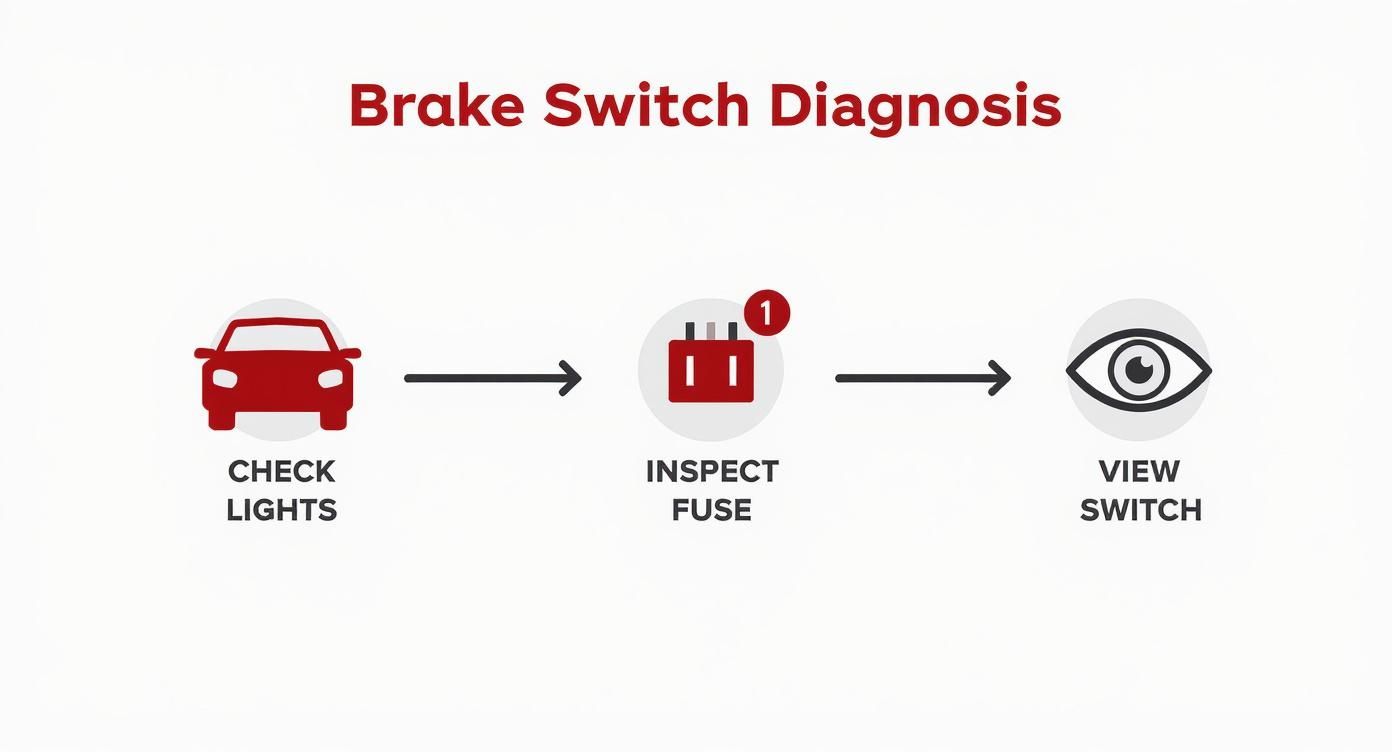
Before any work begins, a good mechanic follows a clear diagnostic path like this. It ensures they've ruled out simpler problems, like a blown fuse or a bad bulb, so you're not paying for a part you don't need.
Is it Worth a DIY Replacement?
With the part being so cheap, you might be tempted to roll up your sleeves and tackle this yourself to save on the labour cost. If you're confident with car mechanics, it's certainly possible. But it's not always as straightforward as it sounds.
The switch is usually tucked away in a really awkward spot up under the dashboard, right by the brake pedal. It’s a cramped space to work in, which can make a simple job incredibly frustrating.
More importantly, getting the installation wrong can cause a world of headaches. If the new switch isn't fitted or adjusted perfectly, you can end up right back where you started, with brake lights that don't work or are stuck on. Worse, you could introduce new electronic gremlins affecting your cruise control or stability control system.
Remember, this isn't just a convenience feature; it’s a legal safety requirement that's been around for a long time. The UK's Road Transport Lighting Act of 1953 made twin brake lights mandatory, a standard fully enforced by 1956. You can read more about these historic safety rules at Advanced Driving. Given its crucial role in preventing accidents, getting it fitted professionally guarantees it's done right, keeping you safe and your car reliable.
How a Faulty Switch Affects Your MOT Test
If you drive a car in the UK, you'll be well acquainted with the annual MOT test. It's the one day of the year your vehicle gets a thorough once-over to make sure it's safe for the road. When it comes to the brake light switch, there’s no room for error—it’s one of those things that simply has to work.
Your brake lights are a critical safety feature, and the MOT tester will be paying close attention. They need to see those lights snap on the second you touch the brake pedal and go out just as fast when you let go. Any delay, flickering, or failure—whether they stay stuck on or don't come on at all—is an instant MOT fail.
Understanding the MOT Defect Categories
A problem with your brake lights isn't just a slap on the wrist. It’s almost guaranteed to be logged as a 'Major' defect on the MOT certificate.
- Dangerous Defect: This is serious stuff. The car poses a direct risk to road safety, and you're not allowed to drive it away.
- Major Defect: This is where a faulty brake light switch falls. It's a problem that could compromise safety or the environment. The car fails its MOT and needs repairing before you can legally drive it again.
- Minor Defect: A small issue that doesn't significantly affect safety, but you should get it sorted soon. The car still passes.
A dodgy brake light switch is a Major defect because it stops you from warning the driver behind you that you're slowing down. This massively increases the risk of a rear-end shunt. Getting caught with faulty lights by the police can also lead to points on your licence and fines, on top of potential DOT lighting violations.
Don't Risk a Re-Test
Failing your MOT isn't just a hassle; it officially means your car isn't roadworthy until the issue is fixed and it passes a re-test. That can throw a real spanner in the works, creating unexpected hassle and expense.
The brake light switch is a small part, but it's the lynchpin of a system that every MOT tester has to check. If you’ve noticed anything strange about your brake lights or you're getting ready for your annual test, it pays to get them looked at beforehand.
Here at Gladstone Tyres & Autocare, we carry out a comprehensive MOT test in York. Our technicians can spot and fix any brake light switch problems quickly, giving you the best chance of sailing through the first time.
A Few Common Questions Answered
Got a question about your brake light switch? You're not alone. Here are the answers to a few things we get asked all the time by drivers in the UK.
Can I Still Drive with a Faulty Brake Light Switch?
Technically, the car might move, but you absolutely shouldn't. Driving without working brake lights is illegal and incredibly dangerous. It leaves you wide open to a rear-end collision, as the driver behind you gets zero warning that you're slowing down. It’s also an instant MOT fail.
What if the lights are stuck on? That’s just as bad. It confuses other drivers and will flatten your battery much faster than you’d think.
Does This Switch Affect Anything Besides the Lights?
It certainly does. On modern vehicles, the brake light switch is a key player in a whole network of systems. A dodgy switch can stop your cruise control from working, light up the ABS or traction control warnings on your dash, and can even prevent a push-to-start car from firing up.
Think of it this way: the car's main computer needs that signal from the switch to confirm you’re on the brake before it allows other functions to engage.
How Long is a Brake Light Switch Supposed to Last?
There isn't a strict "use by" date. How long it lasts really comes down to how and where you drive. They're designed to be pretty robust, but at the end of the day, it's a small part with moving components that gets used every single time you touch the brake pedal.
After years of constant clicking on and off, those internal contacts simply wear out. It's a classic case of wear and tear.
If any of this sounds familiar, don't just hope it fixes itself. The expert technicians at Gladstone Tyres & Autocare can pinpoint the problem in minutes and get your brake light switch sorted, making sure your car is safe, legal, and ready for the road.
Ready to get it checked? Book your inspection online today and let us take care of it.
Article created using Outrank
Winnerspincasino might just be my new lucky spot. Great selection of games, and the bonuses are pretty sweet. Time to spin and win! Try your luck winnerspincasino.